In the 1800s Ireland’s economic development was limited by its lack of mineral resources which were triggering industrialisation in nearby countries such as England and Belgium. It’s geographical position was outside the ‘crossroads’ of international trade. However, Ireland did benefit from the Atlantic trade in its strength area – agriculture. The linen industry was its one industrial success and accounted for around half the value of Irish exports but by 1830s the linen mills began to close.
The French war resulted in a shift to tillage farming in Ireland. There was an increase in subdivided landholdings which managed to feed a growing population. The Irish population exploded between an estimated 5 million in 1800 to 8 million in 1841 as a result in changes to farming practices. However, this galloping population growth resulted in a rural economic depression and a massive influx to Cork city in the 1830s. This rural depression may have brought some of our ancestors into the city. Huge unemployment, including in Cork city itself, led to emigration to Great Britain and North America.
Over two-thirds of the Irish population was dependent on agriculture in 1841. The potato provided a decent diet. However, a potato blight that had been attacking crops in the eastern seaboard of the US and Canada in 1842 appeared in England in August 1845 and was soon after identified in Waterford and Wexford (September 1845) before affecting half the country. A second crop failure in 1846, coupled with a severe winter, sent hundreds of thousands into relief works. The situation reached its worst in February 1847 along with epidemics of typhus, relapsing fever and fatal bacillary dysentery. Scurvy became common and hunger odema lead to starvation. In the early weeks of 1847 small farmers left the country in droves. Six thousand people sailed to Liverpool alone in January 1847. 49 inmates died in the Fermoy workhouse in the second week of February where dysentery was ‘raging violently.’ 5,300 paupers were in the Cork Union Workhouse (Geary, 2018).[1]
In 1846 and ’47 food prices were spiralling and there were food riots. The Cork Constitution described ‘walking masses of filth, vermin and sickness’ (April 24, 1847).
Death and emigration reduced the population of County Cork from 854,118 to 649,903, that is by almost 24%, between the census of 1841 and that of 1851(although the city’s population increased from 80,720 to 85,745 as a result of the influx of rural migrants seeking assistance or awaiting passage to America). While the potato blight destroyed the economy that had grown up during the French wars, famine dealt to the unemployment problem through death and emigration (Green, 2001). Along with this dramatic demographic impact the famine triggered political, social and economic impacts that continued through to the 20th century and are reflected in the lives of our ancestors.
Shandon and Blackpool, north Cork city
Poverty was concentrated in the medieval core of Cork city and in the Shandon Street and Bandon Road areas. These residential areas were generally insanitary and overcrowded. In 1841 72% of families in Cork inhabited slum accommodation. In the first half of the 19th century destitution prevailed in Blackpool and Glasheen due to the decline of the textile industry (Fahy, 1993). A myriad of lanes existed in Blackpool and Shandon where our ancestors lived and these have since disappeared. The middle classes began moving from the medieval centre of Cork into the suburbs and by the late 1800s suburban living was typical of most of the middle class (Fahy, 1993). Despite middle class aspirations, and for some even life styles, our families remained in the central and inner northern areas well beyond this period.
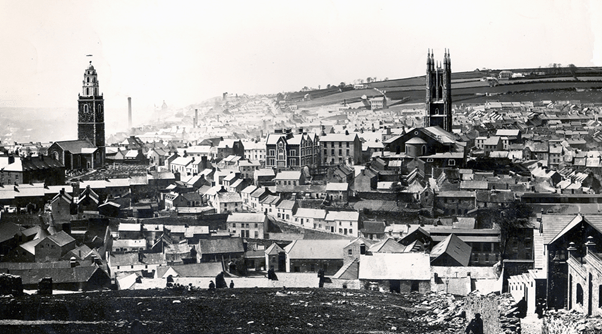
Shandon c.1900s (Lawrence collection, National Library of Ireland)
Top right of this picture as I understand it is the old Fair Field. Cattle drovers originally brought their animals for sale down one of the city’s main arteries known as Fair Hill. This lead on to Fair Lane, which was renamed Wolfe Tone Street in 1899. The (George) DAVIS family lived on Wolfe Tone Street.
Blackpool had developed along the main road out of the city to Dublin and Limerick. From the 19th century it became a manufacturing area, home to some of Cork’s most notable industries including the Cork Dry Gin distillery and the Sunbeam Wolsey textile plant (since burned down). Murphy’s brewery was also a major employer. This made Blackpool a center for thousands of factory workers, and it became known as a close-knit working-class community with a network of sporting and other clubs, for example Glen Rovers hurling club, home of the HYLAND brothers, Jack Lynch and Christy Ring. A lot of the industry moved away in the second half of the 20th century.
As I was working with this material, I was struck by how short-lived my proven family relationship with Cork was. The O’CALLAGHANs largely died out. The TAYLOR origins are unknown. The DAVIS brothers arrived in and their descendants, bar one, have moved away. Many of the FURLONGs moved away. On my mother’s paternal side, the DESMONDs arrived in. The EGANs arrived in and moved away, died out or cannot be located. The HYLANDs arrived in and died out, with one moving away. I may yet be able to go back and sideways and find we are still embedded in Cork city in other O’CALLAGHAN, TAYLOR and DESMOND branches. I would dearly love to know how long we had been a part of the place. We were evidently part of the fabric of the place for a time but drifted off. Our story is one of movement.
[1] https://www.irishexaminer.com/ireland/brutality-of-corks-famine-years-i-saw-hovels-crowded-with-the-sick-and-the-dying-in-every-doorway-470367.html
 In Search of Thomas Davis