There was no record in the 1867 Munster directory of Timothy as an independent tailor. It is likely that he worked for someone else then. It seems unlikely that he was still apprenticed given he had married in 1861 and men waited to marry until they had means to support a family.
In the 1867 Cork directory a number of O’CALLAGHANs were involved in the clothing industry in Cork but there is nothing to suggest they were, or weren’t, related.
In the period that Timothy was starting out the tailors were against any form of piece work and the introduction of sewing machines. A strike originated with forty-two tailors at Keane and Turnbull on the Grand Parade (Lenihan, 2009). In late May 1870 Cork tailors sought an increase in wages from 3 pence to 3 and a half pence an hour. 3d in 1870 is the equivalent of £0.78 in 2017. A pittance. The refusal sparked a tailors’ strike and other workers joined it. The Belfast Morning News of May 30th 1870 reported several master tailors receiving death threats. It was a prolonged strike. On July 22nd tailors attacked and wrecked the homes of master tailors. This was followed by days of violent conflict between tailors, iron foundry workers, seamen, hackney drivers, women workers and the police and military (Beecher, 2005). Was Timothy involved in this strike?
There were no Timothy CALLAGHAN tailors listed in the 1871 Guys Almanac, although there may have been another Timothy CALLAGHAN tailor living in Cork in the 1870s (remember the possible red herring birth certificate for the baby Eugene CALLAGHAN).
In the 1875 Guy’s almanac there is no Timothy CALLAGHAN or O’ CALLAGHAN listed.
In 1881 our Timothy appeared in Slater’s directory as a tailor at 88 South Main Street and again in 1884 Francis Guy’s Almanac.[3] Timothy was listed in the Munster Directory in 1886 at that address as a Tailor.
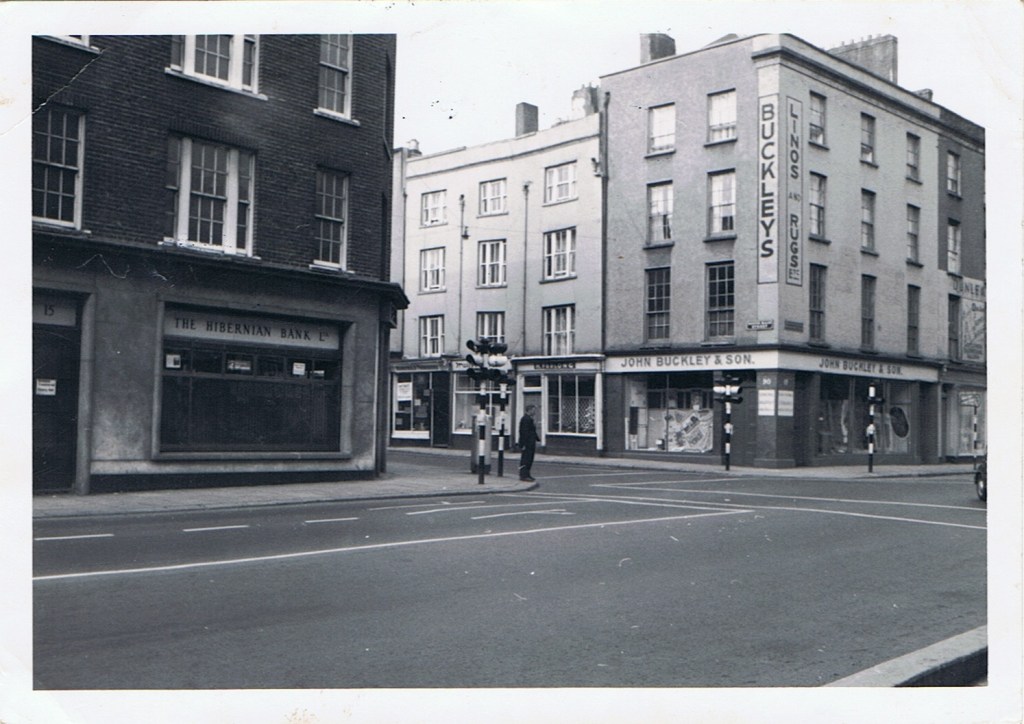
Timothy did not advertise in the Guy Munster Directory in 1886. He was, however, listed at 88 South Main Street (under O’CALLAGHAN) as a tailor in the street directory. By 1888 he called himself a Merchant Tailor, evidenced on Josephine’s birth certificate. He was listed as such in the 1893 Guy’s Directory and the 1910 Guy’s Almanac.
In the 1903 Guy’s Timothy is listed at three of his known addresses.

While there is no evidence to demonstrate that Timothy was active in the tailor’s strike of 1870, we know that he was affected by the tailors’ strike of 1893. Master tailors were head of their shop. The strike started with three shops and then spread, although not all shops were involved in the dispute. One employer, a Mr Pay was attacked by four men on the Wellington Bridge, called a ‘bloody whore’s son’ and he ‘had to draw and use his revolver to protect himself…’ This newspaper article illustrates the use of foul language at the time, tame by today’s standards, and that carrying guns was permissible. Day’s household was harassed and one of his cutter’s seriously assaulted. Another master tailor was jostled roughly on the street and took refuge in SS Peter and Paul’s Church. The Mayor agreed to arbitrate the dispute in May 1893, but workers refused.
The Master Tailors Association operated from 85 and 86 South Main Street. It is not surprising then that Timothy, whose business was at 88 South Main Street, was involved.
The Evening Herald of Wednesday June 21, 1893 carried a story about the strike. Timothy, then a master tailor, ‘whose employees are locked out’ had taken a prosecution at the Police Court against his indentured apprentice.
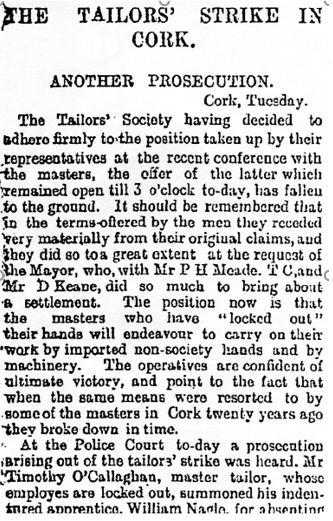
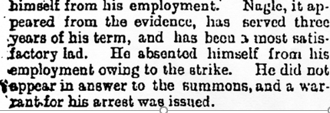
A story in The Irish Examiner, Wednesday June 21, 1893 gave more detail:
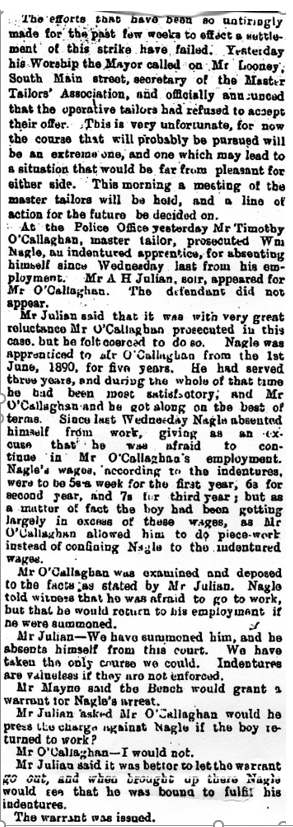
These wages equate in 2017 money to £20.51 a week in the first year of indentured apprenticeship through to £28.72 in the third year.
The Southern Star reported the story on Sat June 24th. It referred to Timothy’s apprentice as Cornelius NAGLE.
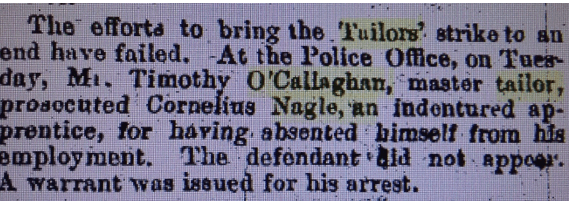
There are no further newspaper articles on this story so it is not possible to say whether or not Timothy’s desire to have his apprentice see out his ‘indentures’ was achieved. There is no William or Cornelius NAGLE, tailor, in Cork in the 1901 census. Could this strike and prosecution have resulted in him losing his trade?
In 1890 the largest Cork tailor shops had 50 workers. They averaged fewer than 14. A grandson[5] remembers the shop as small so presumably Timothy did not have too many locked out employees.
The following article demonstrates another conflict for Timothy. £49, 2 s was then about 148 days wages for a skilled tradesman.[6] Timothy’s son-in-law George DAVIS, Mary B. (Callaghan)’s husband, features in this article.
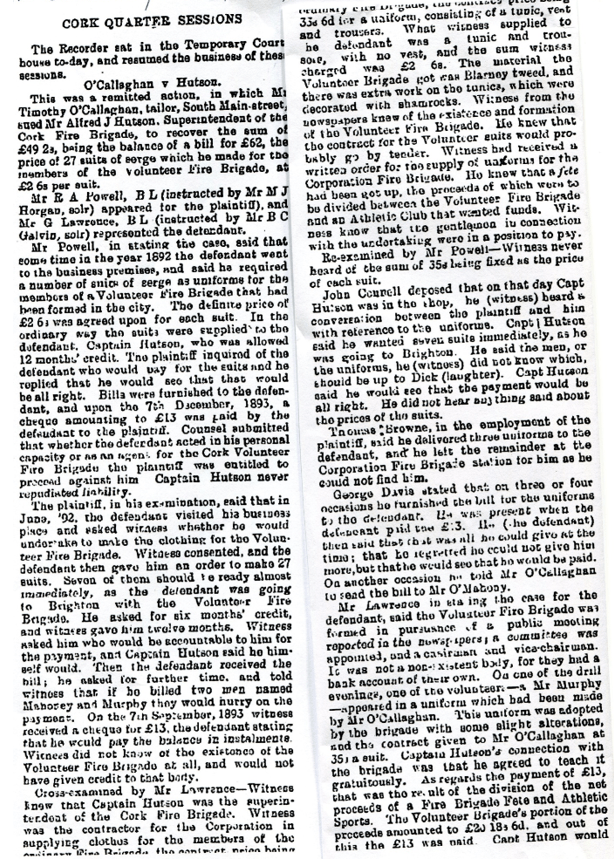
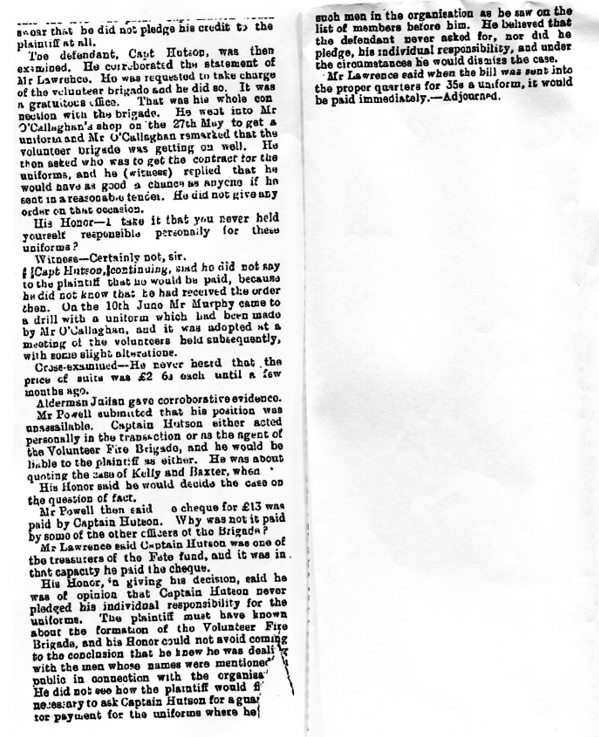
There is a significant discrepancy in the suggested price per suit. £2 6s for a suit is 2017s equivalent of £190.00. 35 s is about £145.00.
The following article published in the Irish Examiner on Saturday June 9th, 1894 tells the outcome of the case.
Cork Quarter Sessions
At the Quarter Sessions, yesterday, a remitted action, in which Mr Timothy O’Callaghan, tailor, South Main street, Cork, sued Captain Hutson, Superintendent of the Cork Fire Brigade, for £49 2s, balance alleged to be due on 27 uniforms obtained for the members of the Volunteer Fire Brigade, was dismissed.
It is unclear why the case was dismissed. Perhaps the agreement to pay 35 s a uniform was acceptable.
Timothy’s grandson, Walter FURLONG, son of Margaret “Babe” took on Timothy’s tailoring business.
[3] Prior to this the 1846 Slater’s directory lists a Eugene McCarthy, grocer, operating from there and in 1871 an E. Mulcahy, grocer.
[4] http://www.corkpastandpresent.ie/places/streetandtradedirectories/1903_guys_complete_reduced.pdf
[5] A son of Ita (Davis) MCGINLEY – the youngest granddaughter of Timothy O’CALLAGHAN by his oldest daughter Mary B. – and the first cousin of my mother.
[6] http://www.nationalarchives.gov.uk/currency-converter/#currency-result
 In Search of Thomas Davis