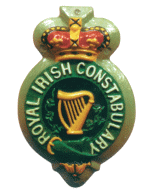
An Act of Parliament in 1822 established the county constabulary subsequent to a system of ‘watchmen.’[1]
Prior to Catholic emancipation Catholics were not able to join law enforcement bodies. The Royal Irish Constabulary (R.I.C.) was established in 1836. The rank and file of the R.I.C. were from a rural background, and predominantly – 80% – Catholic. Officers were Protestant until in the later years of the force Catholics were promoted to officer levels. Fennell described the officers as ‘principally anti-Irish, anti-national and bigoted.’ At its largest, during the land wars, there were 14,000 officers and constables in the R.I.C. Around 80,000 men passed through the force, from its establishment in 1836 until disbanding in 1922 post the 1921 Treaty, so current and former R.I.C. men were a sizable number in Irish society.
The normal minimum age of entry was 19 years. Usually, a man would only be eligible to enlist at a younger age if he had close relatives in the force. George DAVIS was under 19 years, although his first posting did not come until he was over 19.[2] In order to enlist a man had to be recommended by a sub-inspector they were personally known to.
The first allocation took place approximately 6 months after recruitment. The rank on enlistment was 2nd class sub constable. The ranks of Sub constable (second class, and first class) were restyled as constable in 1883. A promotion to first class sub constable was recorded as P.I.S/C and a reversal as R. I.S/C.
Reserves were reportedly select men of imposing stature who formed an emergency response unit that could be despatched to anywhere in the country. They were based were based in the Phoenix Park depot.[3] Patrick HYLAND was a one-time Reserve.
John EGAN, my great great grandfather on the HYLAND side, the first of my known ancestors in the R.I.C. was a sub constable. Ranks after his time became District Inspector, Sergeants, Acting Sergeants and Constables.
Physically, recruits were required to be over 5 foot 9 inches, unless they were the son of a R.I.C. member and then could be 5 foot 8 inches. The minimum chest measurement was 37 inches. While we have records of the heights of our R.I.C. ancestors this chest measurement gives us an idea of their width.
New recruits underwent six months training at the R.I.C. depot in Phoenix Park, Dublin. They were required to possess four linen shirts on joining the depot, and to have £2 for the purchase of necessities and to support themselves until they were paid. This means the impoverished were excluded. Recruits were well disciplined and drilled as soldiers in the use of arms. The Depot was a replica of military barracks. Out of hours they had the freedom to enjoy the city. They were barred from joining political parties or societies, other than the Freemasons.
In 1874 pay for a new Constable recruit went up to £1 per week, with an additional small allowance for boots. Prior to that Fennell describes them as ‘miserably paid’ (p. 9), and therefore the service attracted only an ‘inferior class.’ He stressed that from 1874 there was a ‘better class of recruits.’ This may be biased, given Fennell had enlisted in 1875. However, John EGAN may thus have been from an especially poor background. Recruits had some level of education. They were examined in reading and writing, and basic maths.
The R.I.C. was an alternative to emigration, and there was no shortage of recruits. Fennell noted that the children of men in the force did well, many becoming priests, nuns, teachers, civil servants, bankers and business people. This suggests R.I.C. service was a gateway to upward mobility.
R.I.C. men were considered sought after marriage partners, and suitable husbands for daughter in middle class families. Men should have seven years of service before permission to marry was granted. This was the case with my relatives. Marriage was encouraged by the service, as the resulting commitments obliged the men to keep working under all conditions.
Members of the force were not allowed to own a house or property in the county in which they were stationed. They were also not allowed to own, without permission, a cow, pig, goat, hen or dog. His wife was not allowed to keep lodgers or have an occupation. Drinking by members was considered an offence. Prior to 1880 the men could not even go in to a public house.
Discipline was enforced with the use of punishments. For minor offences, reprimands or admonishments were doled out. Patrick HYLAND received an admonishment in June 1887. There is no record of what his indiscretion was. It seems he was also punished in 1896. Fennell wrote that serious violations could lead to dismissal, and usually involved drink. I suspect James FURLONG’s record would make for interesting reading, given his incarceration in the Public Lunatic Asylum for mania caused by drink.
Prior to agrarian unrest starting in 1879 the police moved freely amongst people and had good relations with the public. Their duties including patrolling rural districts. The R.I.C. acted as the fire service in towns without a fire brigade.
Thomas Fennell repeatedly emphasises in his memoir that the R.I.C. was a machine for enforcing English rule in Ireland.
Cork, Galway and Tipperary were divided into two ridings, with an Inspector in each. Other counties had one Inspector. In rural areas there were 4 or 5 men in stations. Towns had groups of 10 to 15 police, depending on the size. There was a daily morning parade under arms and frequent drills including the handling of arms. John EGAN, James FURLONG, John and George DAVIS and Patrick HYLAND would all have handled bayonets as part of their daily work. Truncheons were only introduced in later years of the R.I.C.
Men could not serve in their own county, or any county they had relations, including the home county or city of their wives. This accounts for the movement of our ancestors from their counties of origin, and in John EGAN’s case, his move from Cork to Lahinch after his marriage.
[1] I have based this description on Jim Herlihy’s book on the R.I.C. and the memoir of Thomas Fennell, an R.I.C. member from 1875 – 1905. Fennell’s period of service overlaps that of George and John Davis, James Furlong and Patrick Hyland, having joined only several months after George Davis.
[2] George’s older brother John was in the R.I.C.
[3] According to Michael Long, R.I.C. historian.
 In Search of Thomas Davis
