Not only was Walter engaged with the Old IRA Men’s group, but he was active in both local and central government politics.
Walter was a long-term member of the Fianna Fáil party[1], which formed in 1926. He was involved in the reorganisation of Cork Fianna Fáil, as evidenced in a letter from him in August 1934 reporting of a meeting to re-organise the PH Pearse Cumann – the local branch of Fianna Fáil.
The “Cork City Management Act, 1929” provided for the election of a City Council of twenty-one members, six Aldermen and fifteen Councillors. The seven members longest in office retired by rotation each year and the vacancies created were filled at a Borough Election held between 23rd June and 1st July. The new members, of whom the first two elected were Aldermen, held office for three years.
From 1935 to 1945 Walter was a Fianna Fáil Cork City Councillor.
Walter and the City Manager
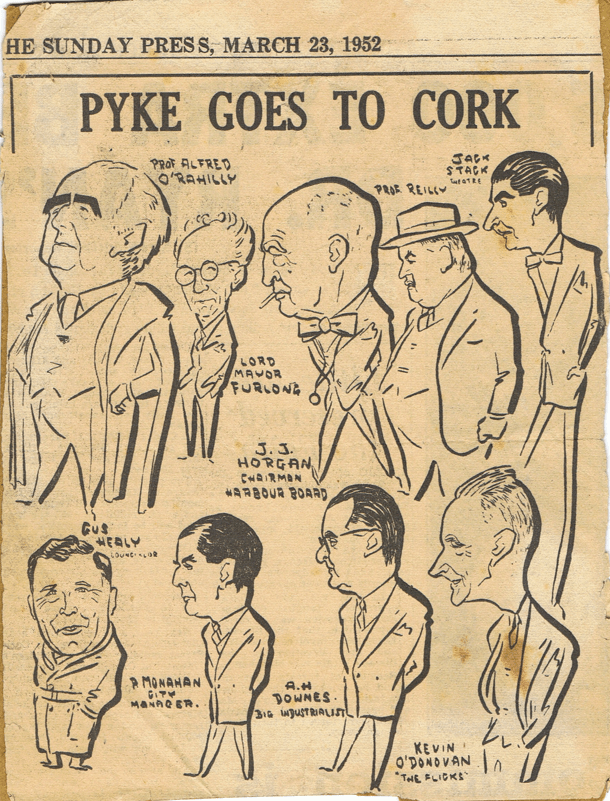
Early in his career as a Councillor Walter can be seen to take a combative approach. In 1935 he was prosecuted for trying to intimidate the Cork City Manager into providing a house for a constituent. Walter had gone to the City Manager Philip Monahan’s home in November, claiming the City Manager had reneged on a promise to provide a house for a constituent, Mr Heffernan, and had instead given houses to others. Walter was described as in “an excitable condition” and it was said that he had threatened to assault Monahan to give publicity to the matter. Walter refused to leave the house without a key for a house for Mr Heffernan, and was arrested (Quinlivan, 2006).
Walter’s case was heard in the “filled” Cork District Court on 2nd December. He was charged with “wrongfully, and without legal authority, used violence or intimidation to Philip Monahan with a view to compel him to abstain from doing, or to do, an act which he had a legal right to do, or alternatively, that he beset the dwelling-house where Philip Monaghan resides with a view to compel him to abstain from doing an act which he had a legal right to do.”
The Irish Independent of December 3rd reported Walter’s claim that he had treated the City Manager and his wife with “every courtesy” and there had been no assault. Walter had “refused to leave the house until the Guards were sent for, so that the matter could be ventilated in public.” The Justice held there was intimidation under Section 7 of the Act of 1875, but he thought it was a case in which an undertaking would be acceptable to both the Garda and Court. However, Walter himself would not accept that.
Walter was then fined 20 shillings and bound to keep the peace for 12 months under a bond of £5.00.
On 21 January 1936 Walter appealed his conviction and fine at the Cork Circuit Court. The judge suggested Walter and Philip Monahan shake hands and asked Walter to apologise. Walter was prepared to shake hands and would apologise if legally required to do so but Monahan would not accept either apology or handshake and Walter’s conviction stood.
There appears to have been a further hearing as the Irish Press reported the story on January 23, 1936 under the headlines “Councillor and City Manager. Happy close to court case.” It described a happy termination. Monahan’s solicitor explained his client had “no animosity whatever towards Mr. Furlong, and …. Would be only too pleased if the matter were ended and forgotten.” Walter, through his solicitor apologised for any technical breach of the law he may have committed in Mr. Monahan’s house. Judge O’Donnell commented:
“… there is none of us who cannot act foolishly… One can understand his zeal for the people whom he represents. Over zeal may sometimes lead one into trouble, but solely with a view to serving those who need is services. I, personally, will go very far to forgive it. He has now done the manly and the proper thing.” The judge went on to comment that “the housing question is the most urgent we have in our cities today. I have felt that, dealing with the criminal cases I had here last week I had to realise that a great deal of crime is due largely, in my view, to housing conditions. I know your Corporation is doing everything in its power but it is not only a local, it is a national question: and until the housing question is settled, and decent home provided for the poor, I don’t see how poor people, living eight or ten in one room, can live as human beings ought to live. It is impossible.”
Judge O’Donnell then reversed the decision of the District Justice.
Housing was clearly a big issue in Cork, though I can’t help but think Walter was lucky to have a judge sympathetic to his stance.
This was a landmark case in Ireland, underlining the separation of elected members from public officials. Quinlivan (2006) highlights the importance of the City Manager refusing to compromise and taking a stand on behalf of public officials. Monahan did so saying “I have to vindicate the right of public officials to discharge their duties without fear, favour, malice or affection. An attack of this character towards the Chief Officer of the City must be regarded with the greatest possible seriousness.”
Tensions in the Council
In an article in the Irish Press, Wed Aug 11, 1937, we can see Walter’s views on rewarding Volunteers. In what we would now understand as an obvious conflict of interest, Walter supported an appeal from the Old IRA Men’s Association, of which he was a member, to ring fence Council jobs for old IRA men.
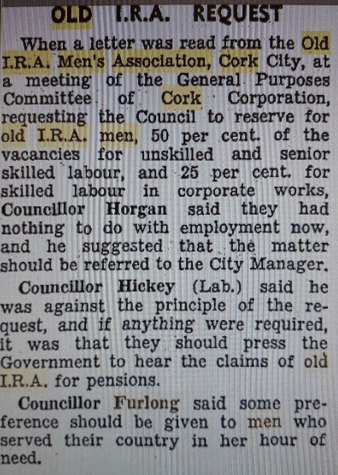
Mr J.M. Buckley commented:
I take it that this letter comes from a political organisation and not for the Old IRA generally in the city. If it came from all sections of the Old IRA it would have my sympathy.
Walter responded that Mr. Buckley should be the last to raise the point as when the party whom he represented were in power they gave preference to ex-National Army men. It is evident from this that there was ongoing tension between the different political factions.
The following article from the Irish Examiner on Tues May 10, 1938 illustrates tensions in the Council and shows Walter as a man who was not likely to back down from conflict.
There was a breeze at yesterday’s meeting of the South Cork Board of Assistance between the Lord Mayor (Councillor J. Hickey) and Walter Furlong, Fianna Fail member of the Corporation.
When a poll was being taken as to whether the tradesmen’s staff in the Co. Home should get two weeks’ or one week’s annual leave, Mr. Furlong declined to vote, and the Lord Mayor apparently passed some remark which was not audible at the Press table.
Mr. Furlong resented the remark, saying the Lord Mayor had sarcastically said to him “We went out to fight for a republic.”
The Lord Mayor said the remark had not been intended to go before the meeting, but Mr. Furlong said he would have to make his position clear in the matter. The Lord Mayor’s remark had reference to his abstention from voting. He (Mr. Furlong) did not vote because he believed if the men were entitled to what they claimed the application should have come from their union.
The Lord Mayor interrupted Mr. Furlong, who retorted heatedly – I would be very sorry for any military cause that would ask you to fight for it. You were a man of military age and you took no part in it.
Lord Mayor – I took more part in it than you did, Walter.
Mr. Furlong – You did not.
Lord Mayor – And I never made mention of what I did.
Ald. Allen – All humbug and trash.
Mr. D. G. Buckley – It was not a case of a republic at all but of more leisure.
Standing for the Mayoralty
In 1937, after the death of Lord Mayor Sean French, Walter was one of four candidates for Mayor. James Hickey was the eventual winner, after five polls.
We can see from an Irish Independent article of 21 Sept 1938 that Walter was again in the running for Lord Mayor.
Standing for the Dáil (Irish parliament)
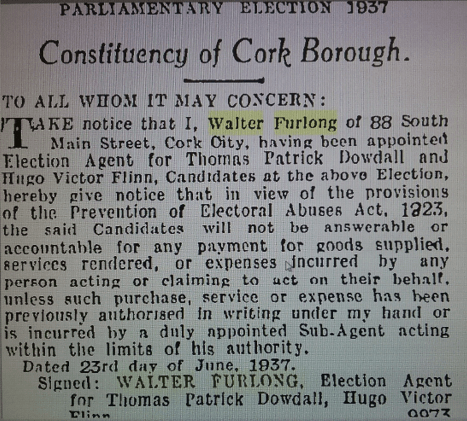
As reported in the Irish Examiner of Monday January 11, 1937 Walter, then a Constituency Delegate, presided over the Annual General Meeting of the Roger Casement Fianna Fáil Cumannan, Ballintemple. We can see further evidence of his involvement in the machinery of the Fianna Fáil party, acting repeatedly as Election Agent on behalf of candidates for the Dáil [2] in the national elections.
The following advertisement in the Irish Examiner, Thursday, June 24th, 1937 was replicated for the 1938 Parliamentary election in the Irish Examiner Wednesday June 08, 1938.
Peace Commissioner
Walter was appointed Peace Commissioner in 1940, announced in the Weekly Irish Times of 16 November 1940. A Peace Commissioner is known as a Justice of the Peace in other countries.
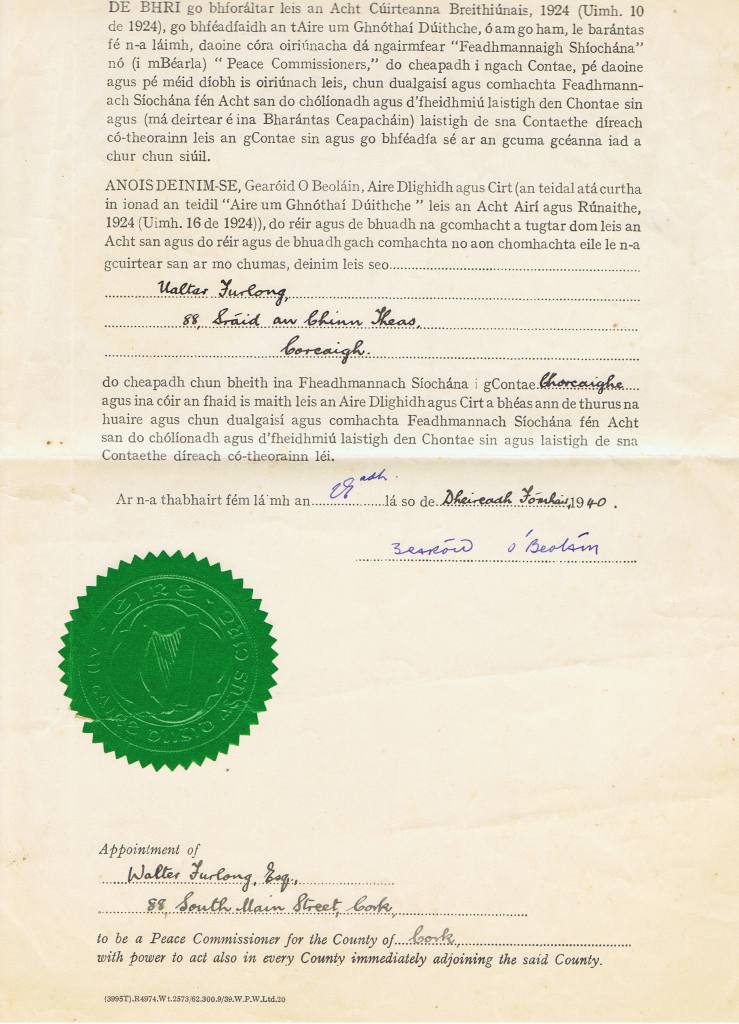
He was listed in Thom’s Directories from 1942-1945 and it is possible Walter was a Peace Commissioner for a much longer period than this.
Standing for the Dáil
Walter again stood for the Dáil in 1943. He was supported by the Old IRA’s Men’s Association but this was not enough to get him over the line. [2]
[1] Fianna Fáil is the republican party.
[2] (Item 604: 7 June 1943, the archives of Seamus Fitzgerald, TD (held by Cork City and County Archives) Item 497 File of Fianna Fáil election leaflets, circulars and newssheets for F.J. Daly, Walter Firlong (sic) and Seamus Fitzgerald (19 items)
This section draws heavily on newspaper reportage at the time and Quinlivan, Aodh (2006) Philip Monaghan: A man apart: the life and times of Ireland’s first local authority manager. Dublin: Institute of Public Administration.
 In Search of Thomas Davis