Republicanism in Cork
Prior to the period known as the Cultural Revival, with the establishment of the Gaelic Athletic Association (GAA), Conradh na Gaeilge(Gaelic League) and Cork Celtic Literary Society (founded in 1901), Cork was referred to contemptuously as “khaki Cork” for its lack of republican activity (McGarry, 2010). Irish Republican Brotherhood members set about infiltrating organisations involved in the Cultural Revival, and local republicans set about building a network.
In 1910, Na Fianna Éireann, a republican group for young men aged 12-18 years, was established in Cork by republicans involved in the O’Growney Branch of the Gaelic League. Its key organisers included Tómas MacCurtain (future Lord Mayor and republican ‘martyr’), Seán O’Hegarty, Seán O’Sullivan, Paddy Corkery, Micheal Ó Cuill, Tadhg Barry, Martin Donovan, Miceall O’Neill, Donnchadh O’Donnaghue, and Ned Rochford. Walter FURLONG was appointed the first Scoutmaster, or Commanding officer, in the city and acted in this training role for a number of months. The title was changed to the rank of Captain after the 1915 Limerick Convention. Recruitment was gradual growing to around 30 boys. They worked on increasing their profile around the city with activities such as putting up anti-British-Army-recruitment posters across Cork in 1912-1913.
The Cork Volunteers of the Irish Volunteers were formed on 14th December 1913 at a meeting in City Hall (Beecher, 2005). Volunteer membership was concentrated in working and lower-middle-class neighbourhoods like Blackpool, where the (George) DAVIS, FURLONG and HYLAND families lived, and Evergreen (Hart, 1993). The tendency was for men to join with members of their family or their peer groups. Volunteers were largely young, and the Cork IRA was male and Catholic, including officers. Women were relegated to supporting roles in Cumann na mBan. The public values of the IRA were temperance, self-improvement and discipline.[1] The Catholic church banned the IRA during the civil war, although almost all were still practicing Catholics.
The IRA companies followed the Straw Boy/Wren Boy model – wearing disguises, robbing mail trains, demanding arms and money. They harassed and expelled people from towns, e.g. “tribes of tinkers” and also killed (Hart, 1993).
Companies were organised geographically. The area covered by D Company, of which Walter was a member, was later described by Seán Ua Luasa (Seán Lucey):
The company area was bounded on the south by the River Lee from Pope’s Quay to portion of Camden Quay, and northwards via Leitrim St., John St., the end of Watercourse Road, Gerald Griffin St. (Cathedral end) on to Fair Hill, from Fair Hill to Shandon St. (and the lanes leading off it at the upper end) but excluding Blarney St. The company area could be said to cover, approximately, three square miles.
Walter and the Easter Rising
Walter was an active member of what we know of now as the Old IRA.
Walter, then a member of D Company, Irish Volunteers, Cork City Battalion[1], was on active service, under arms on Easter Sunday, April 23rd, 1916
Seán Ua Luasa (Seán Lucey) describes this period:
We drilled in the open country at Fair Hill usually on a Sunday. Here we had target practice with a .22 rifle, field exercises and general training. During the conscription threat in June 1918, we had a big influx of recruits. A fair proportion of these remained with us when the conscription crisis had passed, which brought the strength of the company up to about 150.
At this time (1918) we had very few guns. There were a couple of rifles not surrendered in 1916 and about a dozen revolvers. The latter were acquired by various means. Some were bought from the brigade, some came from men employed on ships coming into the Port of Cork, and some were taken by railway workers (who were members of the Volunteers) from the luggage of British army officers travelling by train.
Patrick Higgins, Member Brigade Council IV, Cork, 1916 confirmed that Walter:
was on duty with a rifle and full equipment, marching up and down Sheares Street when he arrived at the Volunteers’ Hall around 6pm that evening.
James Allan Busby, Lieutenant Fianna Eireann, Cork, 1921 also stated:
On Easter Monday morning, 1916, I, with others of the Fianna, reported as directed to Sheare’s St., where I was given a double-barrelled shotgun and told to take up guard duty between the two roofs of the Volunteer hall in Sheare’s St. Three Volunteers named Walter Furlong, Seán Cross and Jerry Mullane, similarly armed, accompanied me. There were a number of Volunteers on the premises. … We were told late in the evening of that Easter Monday that a Rising had taken place in Dublin and Wexford, but I cannot say from where this information came. I have no knowledge of any despatches reaching Cork from Dublin on Easter Monday, 1916, but they could have come without my knowing it.
This passage suggests the uprising in Dublin came as a surprise to the Cork Volunteers.
In mid-1918 the British government proposed conscription for Ireland, resulting in an influx of volunteers and the Cork battalions swelled in number. After the proposal was dismissed half the Volunteers fell away and the First, Second and Third Battalions amalgamated. (Walter’s death notice lists him as having been in “G” Company, 1st Battalion 1st Cork Brigade, Old IRA. I assume the change in Company was as a result of these amalgamations.)
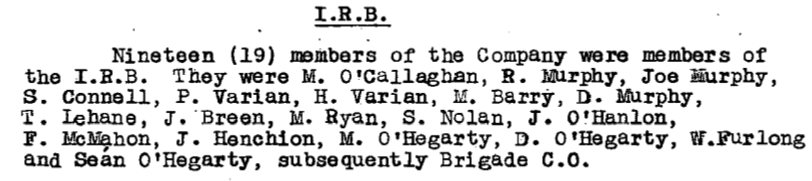
Walter was named in Matthew O’Callaghan’s statement on the activities of G” Company, 1st Battalion 1st Cork Brigade between 1971 and 1921 as having been a member of the Irish Republican Brotherhood:
Walter’s War of Independence
Gun shop raid
During the War of Independence Walter served as Company Intelligence Officer and took part in raids on ‘Marshes and Woodwards’ – I believe this refers to two auction houses in Cork, and on Murray’s gun shop for military supplies.
The raid on Murray’s gun shop on Patrick’s St, November 18th, 1919 is described by Sean O’Connell in his 1957 statement:
The battalion arms supply was considerably augmented as the result of a raid by picked men from the 1st Battalion on the premises of Messrs. Murray, gun dealers, Patrick Street, Cork. The date of the raid was 18th November 1919. For some nights prior to this, a few of us had been detailed to watch the tine at which the shop was locked up and, on the night in question, Tom Crofts, Seán Lucey, Steve Foley, alias McAlister, and myself took up positions in pairs near Murray’s premises. We saw the man locking up the place and followed him to his home at Blackpool where we held him up, took the keys of the shop from him and then handed him up to some of our lads who were waiting nearby, as previously arranged. He was to be detained until the job was completed.
We returned to Patrick Street and entered the shop accompanied by some other 1st Battalion men who were on the look-out for us. It was about half-past seven by this time and Patrick Street had its usual patrols of police, We worked silently and quickly when once we got inside Murray’s and removed to two motor cars, which we had parked outside, up to fifty or sixty shotguns, a large quantity of shotgun ammunition and a quantity of spare parts for guns. A covering party of our lads standing here and there in ones and twos and armed with revolvers, was stationed in the vicinity of Murray’s in case of interference by the police passing up and down Patrick Street. I am sure we were at least an hour in Murray’s before we had cleared everything, which might be of use to us, out of it.
Tom Crofts and I often went with the ‘stuff’ to the White Cross district, north-west of the City where we dumped it in a hayloft owned by a friendly farmer. The guns taken on this occasion formed the main armament in the attack by the 1st Battalion on Blarney R.I.C. barracks in June of the following year.
Walter took part in IRA operations and attacks including the burning of the Cork Income Tax office at South Mall and South Terrace on April 5th, 1920.
Raid and shooting of Captain Clarke at Farran
Sean O’Connell described the raid during which Walter shot Captain Clarke:
Due to the lack of arms and ammunition which restricted the activities of my own Company, as well as every other Company in 5. the Brigade, it was my job as Quartermaster to lay hands on every gun and round of ammunition possible. In common, therefore, with other Companies, we in “G” Company organised raids on houses of people where we suspected guns might be obtained. These houses were, generally speaking, those occupied by ex-British Army or Navy personnel. In several instances we received the ‘tip-off’ beforehand that a shotgun, or, perhaps, a rifle or revolver, might be in a certain house. A raiding party, numbering about half a dozen, sometimes less, would call to the particular house at night and collect the weapon. Invariably One of two of our party would carry a revolver in case any opposition was encountered, the intention being, not so much to use the gun, as to show it in case we met with a hostile reception. The necessity for carrying a gun was made evident from an experience we had when raiding for arms at night at the house of a British Any Captain named Clarke, who lived at Farran, a village about six miles west of Cork City.
So far as I can remember now, we had advance information that Clarke was holding a shooting party on his estate, and, on the night before the ‘shoot’, about eleven of us went out to Farran to raid the house. A few of us, including Walter Furlong (later Lord Mayor of Cork), carried revolvers. Arriving at the house, I knocked on the door while the remainder of our lads were hiding near the steps leading to the house. A maid opened the door. I entered the hail followed by our lad and went upstairs to search the rooms accompanied by a few others. The remainder of our party spread out amongst the rooms on the ground floor. While I was upstairs, I heard a shot. I ran down to the dining room where I discovered that Walter Furlong had shot Captain Clarke in the hand. It appears that Clarke adopted a very hostile attitude and had threatened to shoot Furlong. In fact, he (Clarke) said that if he had got the chance, he would have emptied his revolver into us. I bandaged up his wound which wasn’t very serious, and we proceeded with the search.
In this raid we got a fully-loaded Colt .38 revolver, a Winchester rifle and a number of shotguns. On leaving, we took away Clarke’s motor car into which we put the guns and drove the car to the city where the guns were safely dumped. This was the only instance, so far as “G” Company was concerned, where it was necessary to use a weapon on a raid of this nature.
The nett result of these night raids on private houses could be said to be reasonably good. We did, however, get guns of an obsolete type, which we could not use, for want of suitable ammunition.
Stephen Foley, Lieutenant in Cork IRA, 1918 -1921 described the same incident:
Before reaching Clarke’s house we cut the telephone wire leading to the house. When we knocked at the door we were told that Captain Clarke was out; however, we went inside to search for arms and when one of our party – Walter Furlong – entered a room he found Clarke there. Both men were armed with revolvers and both fired, Furlong wounding Clarke, – We then made a thorough search of the place and got ten or twelve shotguns.
R.I.C. Barrack attacks
Walter was also involved in blowing up a R.I.C. Barracks and was on outpost duty at an attack on the Blarney R.I.C. Barracks. Walter’s involvement in these attacks are particularly interestingly, given his father James and uncle George Davis had been R.I.C. men.
Sean Lucey, Captain IRA, Cork, in 1921 describes the attack on Blarney R.I.C. Barracks:
On the night of 3rd June, 1920, the R.I.C. barracks at Blarney, County Cork, was attacked by men of the 1st Battalion, Cork No. 1. Brigade.
Blarney village in which the barracks was situated is about six miles north-west of Cork City and about four miles north of Ballincollig. In Ballincollig barracks was stationed a large force of British military which it was expected would move to the relief of the R.I.C. garrison when news of the attack became known. On the night of the attack upwards of four hundred men from the lst and 6th Battalions were mobilised. Of this number only about thirty men were engaged in the actual attack. The remainder were detailed to block the roads leading to Blarney to hinder the advance of any British relieving forces from Cork City or from Ballincollig with Tim Lehane, was in charge of about thirty men from “G” Company whose job was to block the road at Carrigrohane. We had some shotguns, two rifles and about seven or eight revolvers. Our position was about half a mile north-east of Ballincollig village and approximately five miles south of Blarney. Earlier that same evening Tony Noonan, an officer in “G” Company, had arranged to have a number of cross-cut saws and axes in the vicinity of Leemount Bridge (which crosses the river Lee at Carrigrohane), the purpose being to fell trees across the roads from Ballincollig later that evening. Our lads moved out to our positions roughly about 7 p.m. on the evening of 3rd June 1920. We held up all traffic on the neighbouring roads and were preparing to cut trees to form road blocks, when, at about 7.30 p.m., to our great surprise, lorry loads of armed military approached from Ballincollig and opened fire on the party of which I was in charge, approximately, three quarters of a mile on the Cork City side of Ballincoilig. We were quite taken off our guard by this sudden, unexpected, development and were not prepared to meet it. However, we got in off the road and opened fire with revolvers on the military, who halted. In view of the fact that our party was dispersed at the time in small groups here and there, with the result that we were unable to bring the concentrated fire of our armed men (few as they were in comparison) on the enemy forces, we had no option but to withdraw. Nevertheless, the action, insignificant as it was, had the effect of delaying the advance of the British from Ballincoilig, on Blarney, as they waited for reinforcements to come up before proceeding further. We suffered no casualties on this occasion, and I cannot say whether, or not, we inflicted any on the enemy.
According to Matthew O’Callaghan they captured a prisoner, took him to Blackrock Castle and later released him.
Further activities of G Company in 1920
On 28 January 1921 the 6th Battalion, Cork No.1 Brigade were preparing to ambush a British convoy in Dripsey, Co. Cork when they were surrounded by soldiers of the 1st Battalion, The Manchester Regiment, and most were taken prisoner. After a military trial on the morning of 28 February 1921 six of the IRA prisoners were executed by firing squad in Cork. One of the executed men was a Daniel O’Callaghan, of Dripsey[1]. That evening between 18.30 and 20.00 hours the IRA retaliated and shot 12 British soldiers on the streets of Cork. Walter was involved in this reprisal, firing on a British soldier on North Main St.
Walter’s internment
Arrested on 18 March 1921, Walter was interned in Cork Prison. At this time Walter is recorded as being in the 17th Infantry Brigade, # 472.
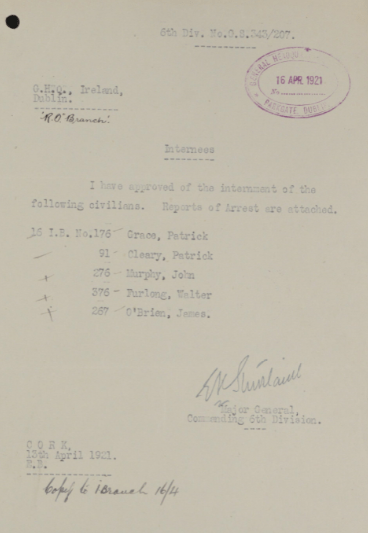
He was then moved on to Bere Island military prison on 1 June 1921.
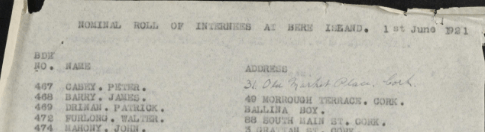
Walter was released on parole in November 1921 when his wife, Helena, was ill. Helena would have also had a new baby to care for at this time, their first son Walter Terence, “Terry”.
Action during the Truce
During the truce period (1921), Walter worked in a Company foundry in Washington St. as part of his Volunteer activities.
On 29 March 1922 the Upnor, a Royal Navy frigate, was boarded by the IRA in Ballycotton Bay, soon after leaving Cobh loaded with munitions. The IRA seized 400 rifles, 700 revolvers, 30 machine guns, and 25,000 rounds of ammunition. Walter transported arms after the capture of the Upnor.
Civil War
During the Civil War (28 Jun 1922 – 24 May 1923) Walter is recorded as having sniped on National Army forces stationed in Technical Schools and the Courthouse.
At least 204 civilians were shot by the IRA in Cork city and county, the vast majority of whom were alleged to be spies or informers. Members of the Cork No 1 Brigade of the IRA executed 26 civilian spies from the start of 1920 to the Truce. Sean O’Connell described G Company’s involvement in what he called the Shooting of Enemy Spies.
A feature of the struggle in Cork was the effective manner in which the IRA dealt with persons who were known to be spying for the enemy. flue to the excellent Intelligence Service set up in each Battalion and Company area, it was possible to bring those informers ‘to heel’ when the evidence against them proved conclusive. Two such instances in which men of “G” Company were concerned may be recorded.
It was recorded to us by the Brigade that two ex-British Army men named Hawkins and Hamill were enemy agents and instructions were given that they should be apprehended and executed.
A watch was kept on the movements of the two spies and one evening, about seven cock, they were held up with revolvers on their way home, by five men from “G” Company. Hawkins and Hamill were then taken outside the City on to the Lee Road and shot. It later transpired that the two men were taken away by the military shortly after being shot. They recovered from their wounds and left the country.
On another occasion we received instructions to arrest another ex-British soldier named Begley who was alleged to be an enemy agent. We watched for him and at about noon one day, Tadg Twohig and I tracked him up Patrick Street. We were ‘covered’ by four or five men from “G” Company, all of whom were armed with revolvers. We arrested Begley and took him out of the City. He was detained for a day or so in a house and on Instructions from the Brigade he was executed by shooting.
R.I.C. men, Black and Tans, soldiers and spies were killed. We will never know quite how involved Walter FURLONG was in any of these actions, although we know from the assault on Captain Clarke at Farran that Walter was willing to use arms.
The Irish Military Archives notes the following about Walter:
- Walter’s civilian occupation was recorded as ‘Shopkeeper.’
- The records confirm Walter was a Private, 1st Battalion G Company, 1 Cork Brigade of the Irish Republican Army, serving under R. Murphy, J. Culhane, Mortimer O’Connell, Tadg Twohig, the Commanding Officers.
- Walter claimed and was awarded, in 1936, a Pension for 2 and 2/9 years’ service in respect of his service with the Irish Volunteers and the IRA “for part or all of the service periods between 1 April 1919 and 31 March 1923 during the War of Independence, Truce period and Civil War.” He unsuccessfully claimed for service in periods between Easter Week 1916 and 31 March 1919. He also had an unsuccessful application for a Special Allowance under the Army Pensions Act, due to excess means.
Post war
Later in his life Walter was involved in the Cork Old IRA Men’s Association. In an Irish Examiner article on Tues Nov 15, 1938 headlined “Bold Fenian Men.” Interesting lecture at Cork Old IRA Club Walter was reported as having seconded a vote of thanks to historian Sean McCarthy for a “most inspiring lecture” he had given to the group on the Fenians. Walter commented that:
Many of them did not realise the task set the men of the Fenian movement. They were, in the main, poor men and illiterate, but they displayed extraordinary tenacity of purpose, and the men of the present generation, perhaps, did not deserve great credit because they had the example of the Fenians to encourage and inspire them. He believed John O’Mahony, the Fenian leader to whom Mr. McCarthy had referred, was the man who inspired Padraig Pearse, with the sentiment of a Gaelic Ireland as a free Ireland (applause).
Walter’s reflections on the Fenians give us insight into his grandfather Timothy’s experience with the 1867 Fenian uprising, and the respect Walter paid them.
Walter’s involvement with Cork Old IRA continued into at least the late 1950s. In 1958 (Sat March 29) the Irish Examiner printed a story on the AGM of the Co. Cork Old IRA Benevolent Association with the headline “Appeal to Old Volunteers to Enrol.” Archdeacon Duggan gave an address which was reported on:
…stated he was very glad to be present that night in the company of men who fought for the independence of their country. Many of the new generation he regretted were not born a generation earlier so that they too could have fought side by side with them. Unfortunately, he continued, there were also some of the new generation who did not appreciate all that the IRA had done in the fight for freedom and ignored the fact that the IRA had done more and gained more in four years than all the fighting units of Ireland in the previous 700 years.
The Benevolent Association provided support to former Volunteers. Walter was voted on the committee.
[1] The Volunteers became known as the IRA when they launched their guerrilla campaign against the British, following imposition of martial law. ‘Volunteers’ and ‘IRA’ seem to have been used interchangeably in the sources I have read.
[2]Source: IRA Commemorative website.
Quotations sourced from:

 In Search of Thomas Davis