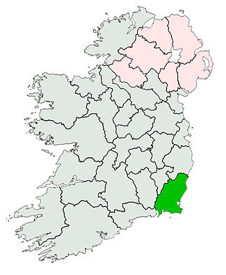
County Wexford has a long history of colonisation. Wexford town was established circa 800 A.D by the Vikings. County Wexford was reportedly the first part of Ireland invaded by the Anglo-Normans from 1170, and some of the largest Norman settlements in medieval Ireland were established in the south of the county. Some lands in the north of the county went over to what’s known as plantation settlements, from 1610, and with the Cromwellian siege of 1649 more English settlers arrived.
Griffiths (1807) references the name DAVIS as early as 1337: ‘In 1337 there was granted to William le Davis, three plough lands and 45 acres.’[1]
The French Revolution took place from 1789 and its impacts could be felt in Ireland – ideas about civil, legal, social and economic equality were no doubt inspiring of and for the largely Protestant initiated rebellion of 1798. The rebellion started in late May in response to a number of arrests of leaders of the Society of United Irishmen but the sectarian rising in County Wexford changed the nature of the insurrection. [2] The rebels, or ‘croppies’ as they were known, won victories against the Crown forces in Enniscorthy and Wexford town. The rebellion was eventually defeated by 21 June. It is likely that members of our family were materially affected by the rebellion – see the ATKINS section. (Propertied Catholics and the Catholic clergy supported law and order, the later arguably because the French revolution had seen a rise in atheism.)[2]
Following the 1798 Rebellion[3] the county benefitted from political stability, and Wexford provided a key port for trade through to Africa, the Black Sea and the United States.
County Wexford was largely agricultural with barley the main crop but potatoes were the most important food source locally and thus the area suffered during the great famine. The potato blight that originated on the eastern seaboard of the US and Canada in 1842, appearing in England in August 1845, was first identified in Ireland in Waterford and Wexford (September 1845) before affecting half the country. My great grandfather George DAVIS and his generation were born just after the famine. The ‘Gregory Clause’ in Ireland’s Poor Law legislation required families with more than a quarter acre to give up their land before they could get poor relief for themselves or their children, in or out of the workhouses. The number of occupants in the Wexford workhouse, built to house around 600, reached 1771. Like other ports there was migration to the new world. Tobin[4] identifies that a class of Irish Catholics survived the famine and benefited economically from it, for example farmers and traders who speculated on food and extended their profits.
After the famine Wexford continued to suffer due to the ongoing agricultural depression. [5] Employment options would have been limited. Looking beyond County Wexford would have seemed an attractive option.
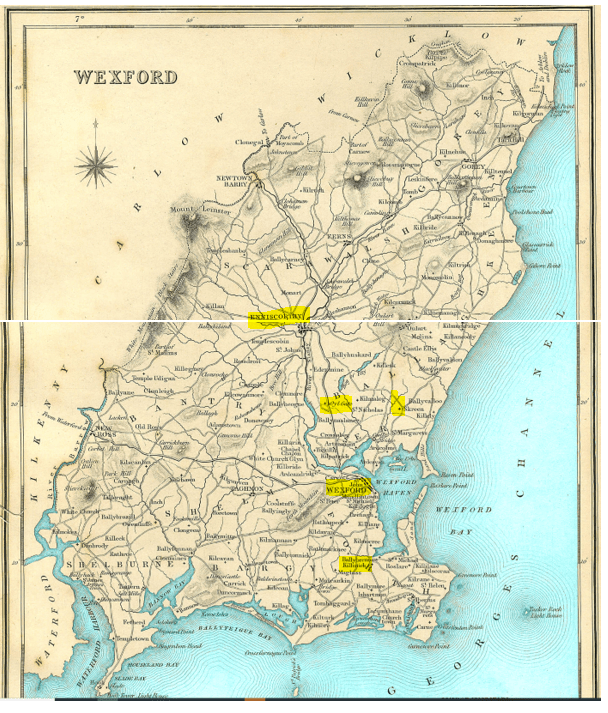
Areas highlighted for our interests: Enniscorthy town, Coolamain / Oylegate, Newfort, Wexford town and Killinick.
[1] “Chronicles of the County Wexford, being a record of memorable incidents, disasters, social occurrences, and crimes, also, biographies of eminent persons, &c., &c., brought down to the year 1877“- George Griffiths Fraser, R. (1807) Statistical survey of the County of Wexford Drawn up for the consideration, and by order of The Dublin Society.
[2] Bowen, Desmond (1978) The Protestant crusade in Ireland 1800-70.
[3]One brief history of this: https://www.theirishstory.com/2017/10/28/the-1798-rebellion-a-brief-overview/#.XrUjc9biuUk
[4] Colm Tobin, writer reflecting on the work of his father, an historian. https://www.lrb.co.uk/the-paper/v20/n15/colm-toibin/erasures
[5] However, the average life expectancy (nationally) went from under 40 years pre famine to 50 by the early 1870s (Source: O Grada, Cormac. Ireland: A New Economic History 1780-1939 cited in Tobin.)
 In Search of Thomas Davis