John EGAN
John EGAN – the father Mary Teresa (Egan) HYLAND – my great great grandfather, was born around 1832 in Tipperary South Riding.
John was a labourer when he entered the R.I.C. on 13 February 1852. This year is frequently cited as the final year of the Great Famine.
At this time, John was 19 -years- old. He was a Catholic, standing 5 foot 9 and 3/8 inches. He was registered as Jno, rather than John.
John was recommended by Sergeant J. Monahan whom he would had to have known personally. In the 1868 Thom’s Irish Almanac and Official Directory of Ireland a John Monahan esq. headed up substation Ballymonty, New Birmingham in Tipperary S.R. (15 kilometres from Thurles, between Urlingford and Fethard.) It seems likely John was from around this area. Two generations later some of his descendants returned to Tipperary, specifically Thurles.
In 1831 – 1836 there were a number of Jno EGAN’s baptised in parishes in North Riding (Toomevara, Borriskoane, Nenagh) but none found as yet in the area that became known as South Riding. A John EGAN was born in Killenaule, 1833, in South Riding. Killenaule is west of Birr, off the R489.
His parents, currently unknown, may be presumed to be John EGAN and Bridget, if Irish naming traditions were followed in his own family.
R.I.C. career

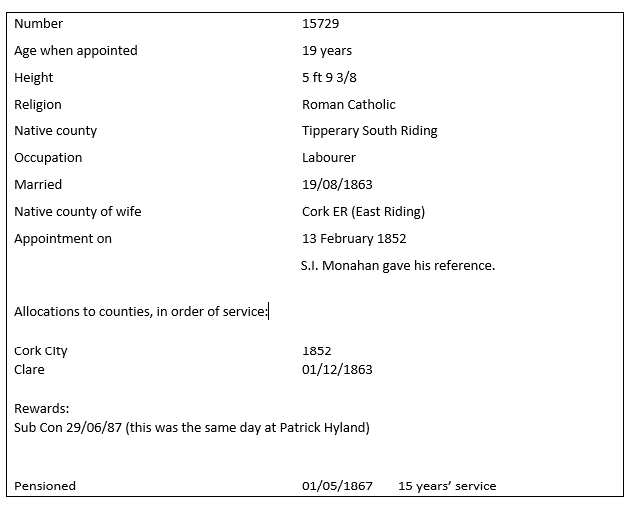
John EGAN was posted to Cork City in 1852 where we might assume John met his future wife, Mary Teresa DESMOND.
According to John’s R.I.C. record:
- He married on 19/08/1863.
- His wife was from Cork East Riding.
- They were both Catholic.
R.I.C. men were not allowed to serve in counties where they had family. John was posted to County Clare on 1 December 1863 before the birth of their first child, John, who was born less than four months after their marriage.
John was pensioned from the R.I.C. on 01 May 1867. He had served just over 15 years. John received 3 pounds and 5 shillings per quarter as his pension.
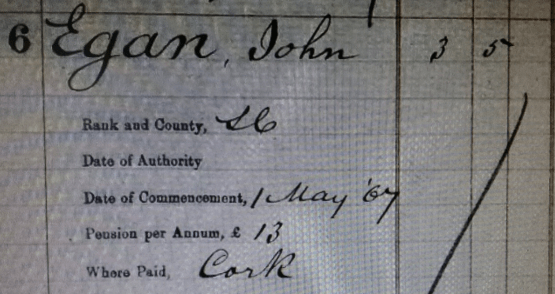
The timing of John’s retirement from the R.I.C., several months after the Fenian uprising, may be coincidence but it may also suggest that John was conflicted about his position in opposition to the uprising. While the uprising was not as significant an event in Clare, unlike in Cork and Tallagh, the Kilbaha West Clare coast-guard boathouse was attacked by five Fenians on Shrove Tuesday 1867.
Mary Teresa DESMOND
Mary was from Cork East Riding.
If Mary Teresa DESMOND and John EGAN had followed Irish naming traditions with their children, we would expect Mary’s mother to have been Julia and her father to have been one of John/Joseph/James.
Mary had a younger sister Norah/Hannorah/Hannah/Nora. We know from the Census records that Nora DESMOND lived with the Egan family.
The 1901 census puts Mary’s year of birth at around 1842 and Nora’s at 1845. Their death certificates suggest 1846 for Mary and 1848 for Nora.
Given their ages, the sisters had survived the famine and were possibly born just before or during it. I have been searching Cork East parish records but to date have not found the DESMOND sisters under those names.
Marriage
As noted according to John’s R.I.C. record he married a woman from East Cork, on 19/08/1863 and both were Catholic.
As yet, I have not found a record of this marriage. They did not marry in any of the Cork city parishes 1861 – 1863, nor Blarney, Killenaule, or Clare where John was posted after their marriage, on or around this date.
Did John and Mary marry well into the first pregnancy, or was the marriage date incorrect?
Could Mary have been married and widowed and John stepped in, thus Mary married under her married name?
As yet I have been unable to find any marriage record for John/Jno/Johannes EGAN /Regan/Eagan around that period. It seems probable therefore they married in a parish where there are no surviving records.
Children
John EGAN and Mary Teresa DESMOND had ten children that I have been able to document. Mary gave birth to the first child in Cork, the second in Lehinch town, Co. Clare where John was posted, and the remaining children in Cork city.
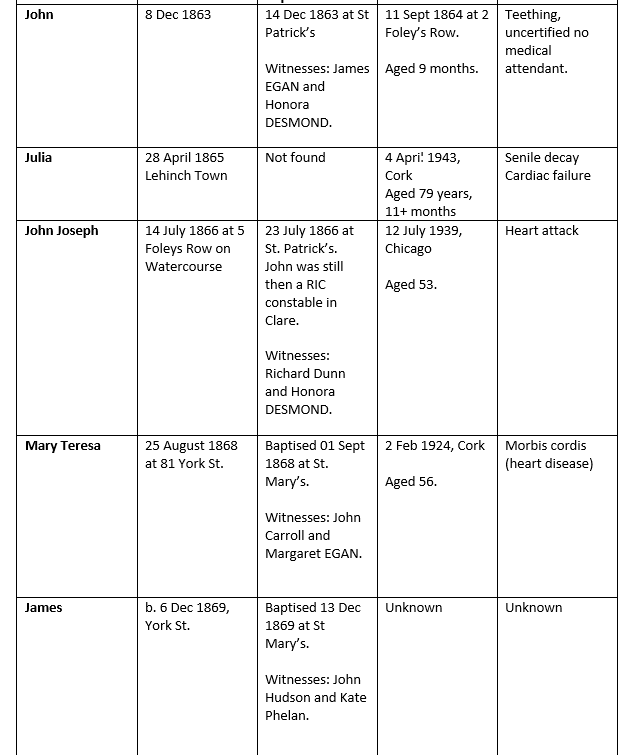
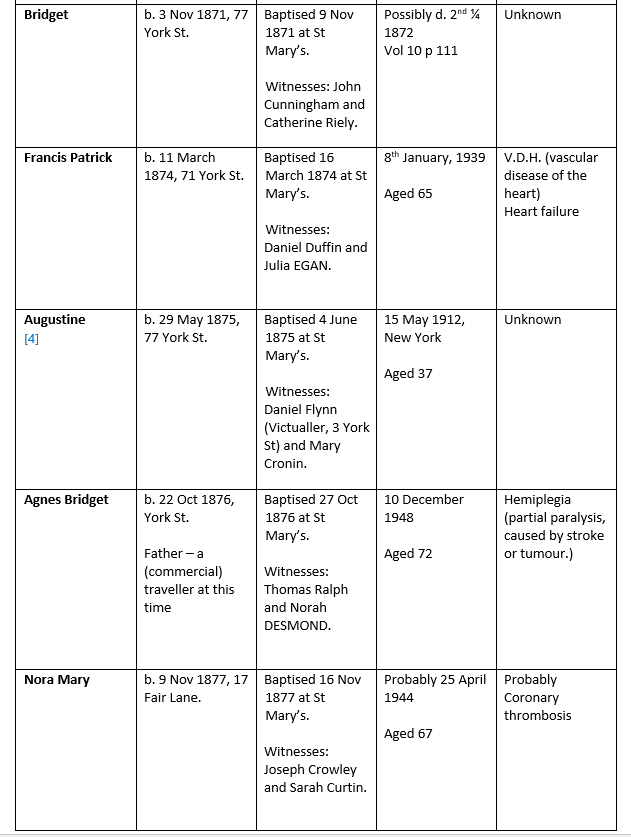
Work post R.I.C.
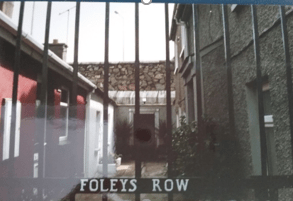
The next evidence of employment for John is as a Prison Warder, in 1868. There is no record of John having applied to the National Prison Board in the years 1846-1868, which covered Spike Island. He may have worked at one of the other of three Cork gaols, that is, Cork City or County gaol.[1]
By 1877 John was a Travelling representative, also known as a Commercial traveller. He continued in this role until the end of his working life.
Mary (Desmond) EGAN was a milk vendor, evidenced in the 1901 Census.
Census records
In 1901 Mary Theresa (Desmond) EGAN and three of her children lived at 24 Easons Lane, North West Ward, Cork. [2] Mary was listed as the wife of the head of the house, 59 years – married, not widowed – and a milk vendor. Husband John EGAN was not on this record. Sister Nora DESMOND was there, unmarried, of no occupation and aged 56 years. It’s likely she was the family housekeeper. Also at the house was Mary HYLAND, aged 11, a scholar, Mary Teresa’s granddaughter. This child is my Great Aunt Mollie.
Mary T. and her sister Nora record they were born in ‘Cork County’.
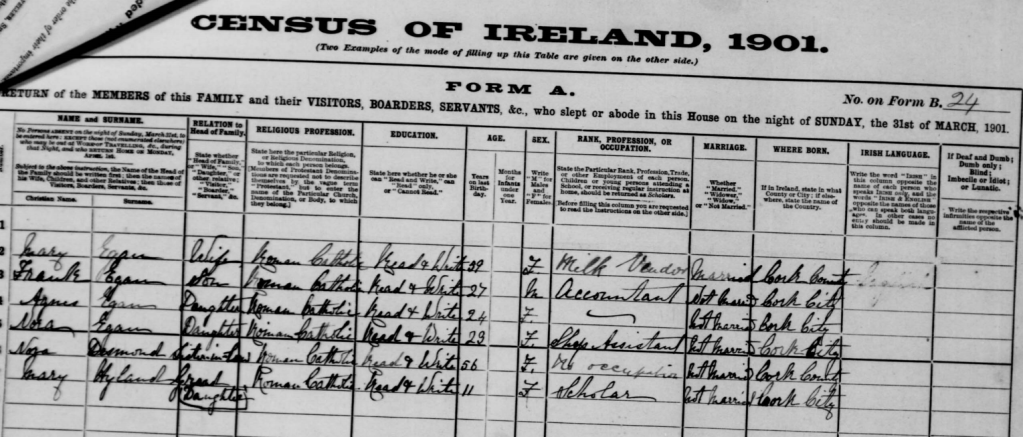
Interestingly, Mary was recorded in the 2nd line of the census, leaving the first line blank, suggesting that space was left for John EGAN.
The EGAN’s house, although considered 2nd class, had five or six rooms, and three windows to the front.
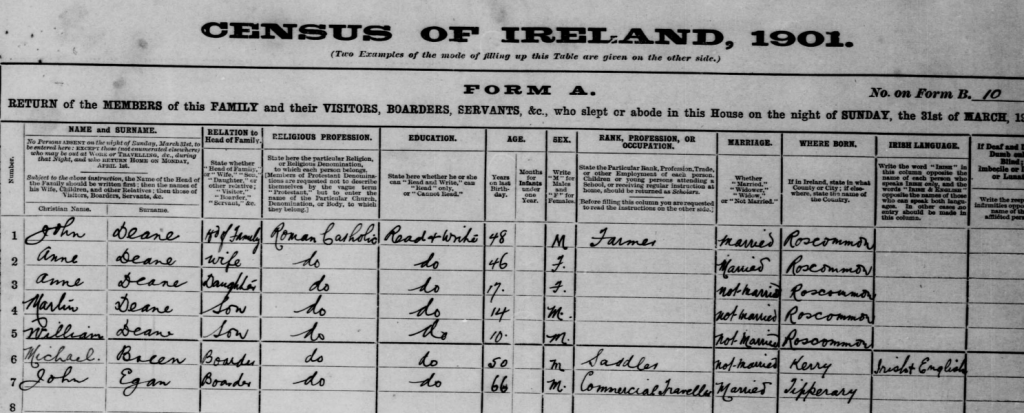
I eventually found John EGAN in the 1901 census. He was recorded as a married, literate, 66-year-old Commercial Traveller, born in Co. Tipperary. He was boarding at 10 River St, Ballinasloe Urban, Co. Galway. The space left in the 24 Easons Lane census record suggests John may have been expected home in time for the census but did not return from his work trip.
Deaths
Mary Theresa (Desmond) EGAN died on 2 March 1905 at 6 Cathedral Place.[1] She was recorded as aged 59 years (the same age she was recorded as in the 1901 census). Her death was registered by Julia BUCKLEY, her oldest daughter.
The cause of death was Phthisis, 8 months – pulmonary tuberculosis.

Mary T. is buried at St. Joseph’s cemetery.
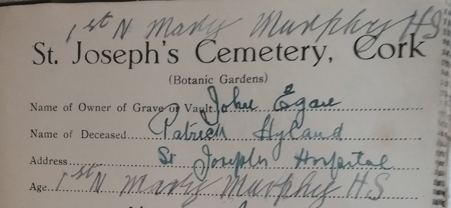
The remarks in this entry show that Mary T. was buried in the 2nd section, north of a Mary Murphy’s head stone.

She was therefore buried with her granddaughter Agnes HYLAND who’d been interred there just over a month before.
The plot in Section 2 of St. Joseph’s cemetery had been purchased by John Egan, as is evident in subsequent Hyland burial documentation. There is no headstone and Mary Murphy’s grave is no longer visible.
John EGAN died a little over a year after his wife in 1906. He was recorded as being 71 years, suggesting a birth year of around 1835, not far out from an estimated 1833 of his R.I.C. record and consistent with his given age in the 1901 census. His death was registered by his daughter Nora and cause given was Senile debility, certified.

John was buried alongside his wife and granddaughter Agnes at St. Joseph’s cemetery.

There is no record of a will.
Nora DESMOND
Mary Theresa Desmond/ EGAN’s younger sister Nora lived with her sister’s family for years. She witnessed the baptisms of three of Mary’s children, registered the death of baby John in 1863 and registered the births of my great grandmother, James and Bridget.
Nora lived on with her nieces and nephews after the death of her sister and brother-in-law as can be seen in the 1911 Census where she was recorded as Honora :
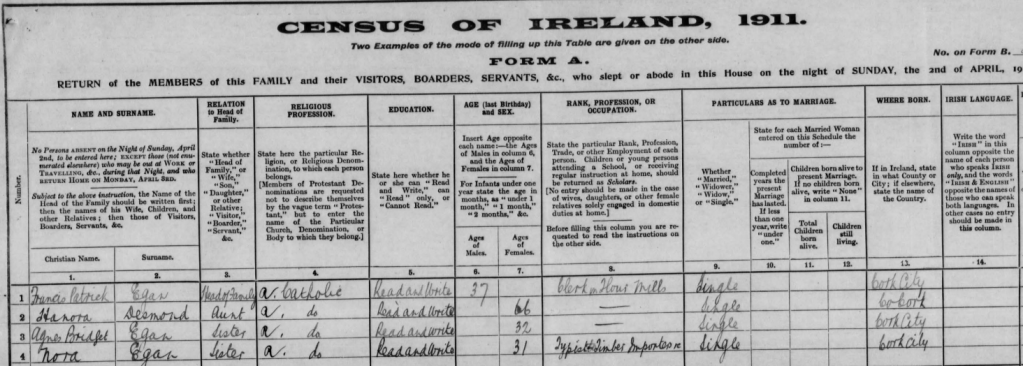
Nora died almost nine years after her sister, in 1914, at 6 Cathedral Place. She was recorded as being aged 63 years, having been listed as 56 in the 1901 census and 66 years in the 1911 Census.
Norah had been a housekeeper. Her niece Nora EGAN was present at her death. Nora DESMOND died from Cardiac causes and “general asthenia” 2 months certified (general debility or weakness).
Nora, having seemingly spent her life with her sister Mary, was buried with her at St. Joseph’s, in the 2nd section, north of Mary Murphy’s head stone.

There is no record of a will.
[1] The Cork City Gaol building was completed in 1824. Prison wardens were said not to be held in high esteem in society. Warders lived in, in the Governor’s house or part of the prison. Staff comprised of the Governor, 23 staff and nine turn keys. The city jail housed men and women from 1878 – 1920 when the men moved to the County jail. It closed in 1923. (Source: Cork City Goal Museum)
[2]Eason’s Lane was off Rogerson’s Lane, off Shandon Street and was renamed Cathedral Avenue. It is likely the family did not move house, rather the street was renamed.
[4] The State registration was of Augusta (female). This was on a record that originally named the parents as John and Mary Nagle, which was struck out and replaced by EGAN. Presumably the registrar did not change the Sex to M.
 In Search of Thomas Davis