In the 15th century Rathangan (west County Kildare) was under the control of the O’CONNOR family. HYLANDS were appointed as rectors – the role was to look after the land. When the Earl of Fitzgerald regained control he continued to appoint HYLANDs as rectors.[1] The Fitzgeralds had been at Morette Castle since 1580.
An early reference to the Hyland name in County Laois – formerly known as Queen’s County – was in the townland of Rathronshin or Ballepoble, now Bellegrove, which runs from Ballybrittas back in the Portlaoise direction. In September 1617 in a Queens County Chancery Inquisition held at Maryborough Sir Terence O’Dempsey Knight of Ballybrittas was in possession of the O’Dempsey lands in the area which included Bellegrove. The extract from the Inquisition reads “Rathronsy, Ballypoble, or Ballifoboyle and Boretoban, one plowland; occupiers, Murtagh O’Dempsie and Shane O’Healan, lying from the lands aforesaid westward, and neareth upon the River of Glasee-Evarragh south.” (Variants of the HYLAND name were numerous in the sixteenth century in Laois and Offaly. [2])
Local tradition has it that the Hylands had their origin adjacent to the “Montague Hotel,” a few hundred yards to the south of the townland of Morette.
The William Petty 1659 religious census for Oliver Cromwell shows that there were six families of Healans in Morette and one near Ballybrittas.[3]
A John Hyland was later documented around Mountmellick in 1756 and he was a large tenant farmer[4]. Under tenants were not then listed.
In 1771 William Hyland leased 3 and a half Irish acres at Morette at £1.00 an acre. The land was on the road from Morette to Coolbanagher, believed to be owned and farmed now by my relative JH (living). The lease was witnessed by Richard Hyland, who signed his name, and later witnessed one of the Fitzgerald’s wills in the 1780s, suggesting he had some standing.
The Hylands spread to the south across the Heath to Ballydavis and Raheenaharan, listed as tenants in the late 1700s.
We can trace our Hylands back through Morette in the civil parish of Coolbanagher.
The estate papers of the Marquis of Lansdowne held at the Bowood Archive show John Fitzgerald tenant in Morette died 1790 and his (sub) tenants were listed and given leases in their own right.
The Hylands featured very strongly (1790):
| A | R | P | Rent | |
| William Hyland | 94 | 1 | 7 | £ 56-11-6 |
| John Hyland | 30 | 0 | 0 | £ 17-19-4 |
| Richard Hyland | 77 | 2 | 16 | £ 88-5-5 |
Local historian, JH explained the following:
They had 21 year leases from March 1791.
There was a famine in the district in 1800 which caused distress and difficulty in paying the rent, the money going to buy food.
The Hylands travelled to London with the Mulhalls (another local family) to see the Marquis of Lansdowne regarding their leases which a new agent intended withdrawing. They apparently settled circa 1810.
William Hyland and sons were tenants in Morette then, leasing land from the estate of the Earl of Portarlington. We (all the local Hyland branches) are all descended from that William.
The Irish language likely died out around 1820 in the area. There had been a lot of English influence with Maryborough being a garrison town. The Heath was used for manoeuvres by the Leinster regiment.
The Tithe Applotment records of 1826 show three Hyland leaseholders in Morett, Coolbanagher. They are John, Richard and the widow Catherine.
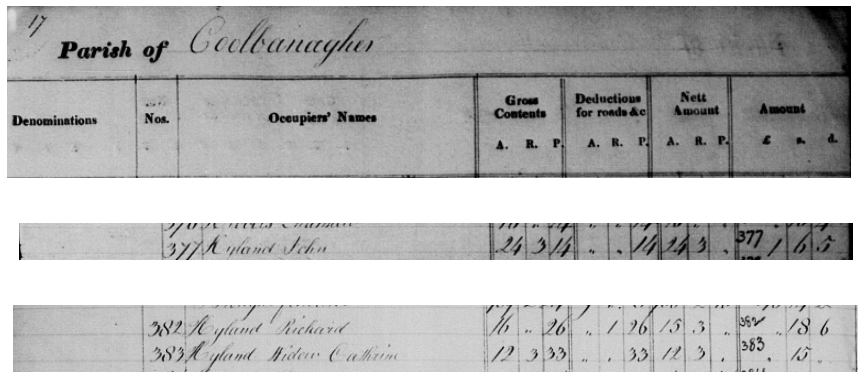
John is likely to be our direct ancestor (and thus likely my great, great, great, grandfather).
The Earl of Portarlington reportedly died penniless in 1845, with the Morette estate in debt to the current equivalent of £26 million. His title was passed on to a cousin. Following the Encumbered Estates Act the court directed the sale of the Earl of Portarlington’s estates and the indebted Emo Park Division, which included the Morette estate, was offered for sale in 1852. The new Earl sold his English estates in order to repurchased the Emo estate.
Four Hyland families, all related, made up the group of what is known as the ‘Morette Hylands’. Two families were first cousins and they were the second cousins of the other two families. The families appear to have followed the Irish naming pattern and therefore there were a lot of Michael, John, William, Bridget and Catherine Hylands around. The families had nicknames to distinguish them from each other. Our Hylands were known as The Longs due to their height. Another Hyland family was known as The Yellas. JH’s grandfather John Hyland was known as Johnny Blue; he thinks that was to do with a suit.
The Hylands would have carried out mixed farming, some tillage, barley as a cash crop and raised cattle, sheep and pigs.
Coolbanagher
The Coolbanagher burial ground likely contains some of our ancestors. It is located immediately west of the local road, and marked on 1st and 2nd edition OS maps as “Coolbanagher church (in ruins).” The graveyard contains the ruins of a medieval church with both gables and walls remaining. The church measures c. 19 m by 7m, and consists of a chancel and a nave with a Romanesque doorway in the west gable. There is evidence of two phases of construction, and restoration.
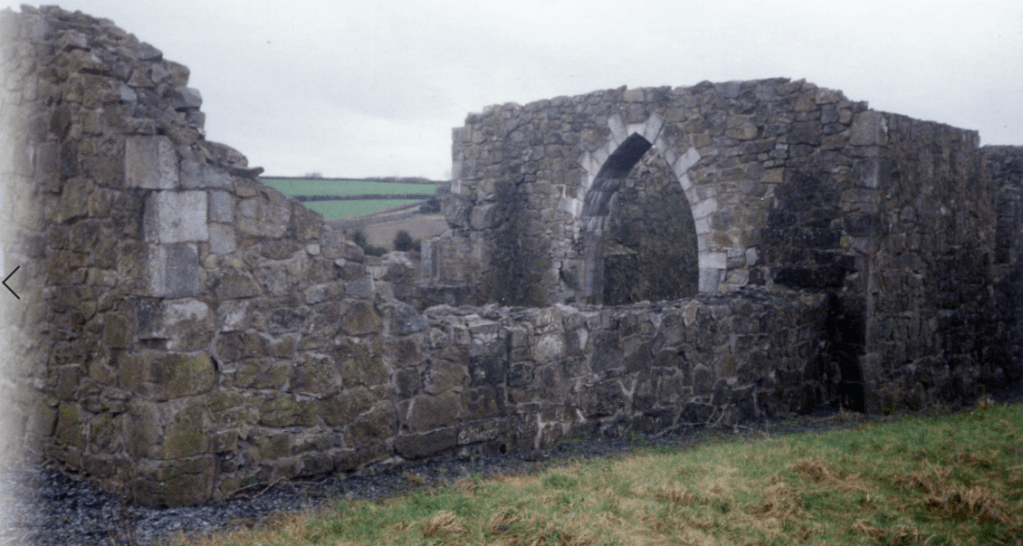
The graveyard contains visible 18th century headstones, including that of a Richard Hyland. Two flat slabs also inter John Hyland and Gregory Hyland. The earliest inscribed memorial dates to 1728 for a Henry Toole. The religious denominations of the people interred are not clear. [5]
Hyland families from the 19th century are buried near the old church at Emo, which has been removed.
Morette
This place name comes from the Irish Magh Riada or Moy Reta which means ‘The Plain of Riada’. This was the old name for an extensive plain which included The Heath. Some historians believe that there used to be a stone here called Leac Riada. This stone marked the spot where the borders of the lands belonging to the Seven Septs of Laois met. The Seven Septs (tribes or families) of Laois were the O’Moores, O’Kellys, O’Lalors, O’Devoys, McEvoys, O’Dorans and O’Dowlings.
According to historian JH (living) Morette had its origins as a defined area circa 1298 when it was a Norman estate.
Morette Castle, which once belonged to the O’Dempsey and Fitzgerald families, is now in ruins. It is on private property and not open to the public. Nearby are the remains of a well dedicated to St. Brigid.
I am indebted to local historian and my distant cousin, JH, for his extensive research and generous sharing of background information on the Hylands of Morette, their likely origins, and the history of the estates of the area.
[1] JH (living) thinks the Norman FITZGERALDs may have brought the Hylands over with them to manage their lands.
[2] Rev. Patrick Woulfe (1923)Sloinnte Gaedheal is Gall:Irish Names and Surnames.
[3] Published 1939. Available from the Stationery Office.
[4] In the deeds of Shane and Kilmurray manors sold in 1755.
[5] Source: Laois Burial Grounds Survey 2011. Vol. 2: Gazetteer of Burial Grounds.
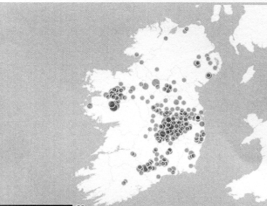
In the Primary Valuation Property Survey of the mid 1900s there was 116 Hyland households in County Laois. The next Hyland stronghold was Mayo at 83 households.
 In Search of Thomas Davis