Denis was the youngest of Timothy O’Callaghan’s children with his first wife Margaret (Taylor), his youngest son and the only son I believe to have survived infancy. He was born on Fair Lane on 18th December 1878.
On the surface, Denis followed in his father’s footsteps becoming a tailor and he lived in the family home. However, much to my initial surprise given his father’s Fenian activities, Denis enlisted in the Army.
Denis first enlisted with the Royal Munster Fusiliers on 6th November 1895. His record shows him as 18 years old. He called himself a labourer. However, Denis was actually only 17 years old.
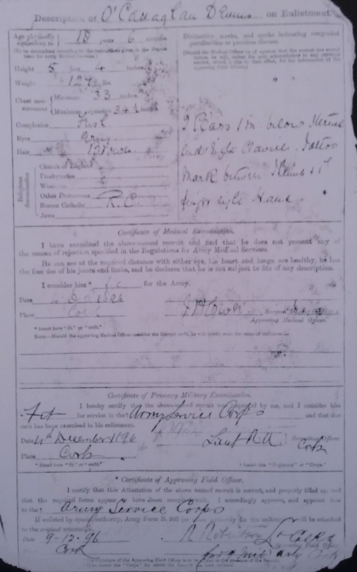
Denis was not a big man. His records show he was 5 foot 4 inches, 122 pounds (8.7 stone; 55.3kg), with a 33-inch chest that expanded to 35 inches. With hazel eyes and brown hair Denis also had a tattoo of his initials – DOC – on his left forearm. Having enlisted it seems that Denis was ‘discharged by purchase’ on 15th November 1895. This means Denis bought himself out of service. [1]
Cork historian, Tim Cadogan (2003) noted that the military presence in Cork was a significant social and economic factor in the city and evoked little resentment from the general public, prior to the War of Independence. It is perhaps in this spirit that Denis enlisted. I do wonder if he enlisted to make a point to his father.
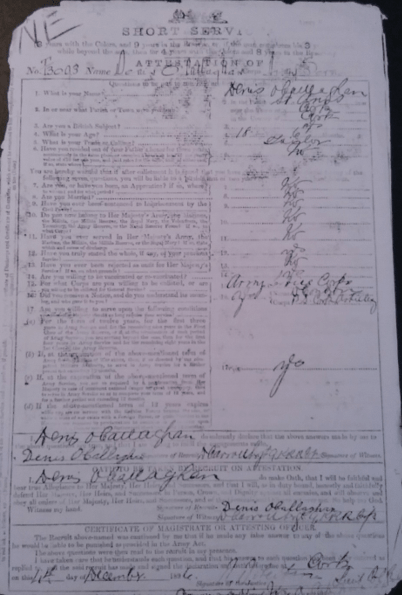
In 1896 Denis then joined the Army Service Corp, registering as aged 18 years and six months. He was in fact just over 18 years and a month. His regimental number was #15338. He was in the army for 58 days. His record shows that Denis had received a ‘Notice’ and I am trying to identify what that means, given he had previously bought his way out.
The Short Service Attestation Record gives us another physical description of Denis. He’d thickened out a few pounds, weighing 127 lbs (9 Stone or 57.1kg). At 5 foot 4 he was 2 and a quarter inches taller than the minimum requirement for the Army Service Corp. His chest was 33 inches with the maximum extension of 34 and ½ inches. Denis’s eye colouring was this time recorded as grey.
Denis had two scars. He had a scar under his right clavicle and some (illegible to me) marking under his right eye. By 1896, Denis had a tattooed mark between his thumb and the first finger of his right hand.
Denis named his next of kin as:
- Father Timothy Callaghan (2) St. Mary’s Rd.
- Sister Maggie Furlong 17 Shandon St.
- Sister Mary Davies (sic) 13 Nile St. (Now called Sheares St.)
Denis was now a tailor. According to this document Denis had never been an apprentice. Presumably this means he was working with his father to learn his trade, without the formal, indentured aspect of apprenticeship.
There is a gap in time, with Denis returning to the Army Service Corp in 1900.
Enlistment in the army had been increasing in Cork, and in 1900 troops were being sent to South Africa to the Boer War.
Denis has an attestation document of 11th January 1900 and did home service. During this period, it was noted that Denis had sustained an injury in service, a poisoned wound on his right hand (19 Jan 1900). A court of inquiry into Denis’s injury found that it was an accident of duty and not Denis’s fault.
Training for the Army Service Corps was undertaken at Aldershot in Hampshire, England, and Denis attended Aldershot in England on 20th January 1900. By then Denis had a tattooed flag around his DOC tattoo and a tattoo of a harp on his left forearm.
It seems that military life did not agree with Denis. The next record I found shows that he was awaiting trial on 30th May 1900. He was convicted and imprisoned on 16 June 1900 for breaking out of barracks and drunkenness. He returned to duty on 14 July 1900, but on 30th July 1900 Denis deserted from Aldershot. He was then discharged rom the army for misconduct, forfeiting any pension.
A notice of Denis’s discharge for misconduct was placed in The Police Gazette of Tuesday August 7th, 1900.

It seems to me that Denis was a fairly spirited young man: scarred, tattooed, and likely rebellious against his father and then the military. However, he returned home to his father’s house and business.
Denis remained single despite having the potential to take on his father’s business which would have provided for a family.
Searches of newspapers from the period draw a blank on Denis, suggesting he did not get into any further trouble.
Denis died in 1909 of tuberculosis at St. Patrick’s Hospital, later known as Marymount Hospice, on Military Hill, Wellington Road, on Cork’s north side. He had spent five weeks in hospital before his death. Denis was 27 years old.
Cork Examiner death notice
Friday morning October 15, 1909
DEATHS
O’Callaghan – On Oct 14th, a St. Patrick’s Hospital, Wellington Road, Denis, youngest and only surviving son of Timothy O’Callaghan, Fair Hill House. Deeply regretted. On whose soul, Sweet Jesus, have mercy. R.I.P. Funeral arrangements later.
A further notice was published in the Cork Examiner:
October 16, 1909
DEATHS
O’Callaghan – On Oct 14th, Denis, youngest and only surviving son of Timothy O’Callaghan, Merchant Tailor, 88, South Main street. Deeply regretted. On whose soul, Sweet Jesus, have mercy. R.I.P. Funeral from Cathedral on tomorrow (Sunday) at 12 o’clock for Garrycloyne.
Denis did not leave a will.
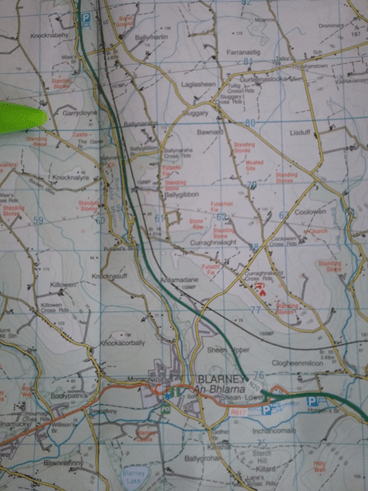
Denis is the first member of the family we have evidence of having been buried at Garrycloyne cemetery, six miles north west of Cork city and Blarney. I tried to get the Garrycloyne cemetery records from the Parish priest in the early 2000s, but they were not accessible.
[1] The Army Enlistment Act of 1870 established the Short Service Enlistment where an infantry soldier enlisted for an initial period of 12 years, but also allowed him to serve part of the 12 years with the Colours (in a regular army line regiment) and the remainder with the army reserve (discharged to civilian life but with a commitment to part-time training and recall in the event of an emergency). The period spent with the Colours vs Reserves varied but was initially split into two periods of 6 years. Soldiers who served a full 12 years with the Colours could re-enlist for a further term to take their service to 21 years.
Initially Short Service Enlistments didn’t apply to all Corps and in 1874 the minimum service in most cavalry regiments was set at eight years with the Colours and four years Reserves.

