Great Aunt Mollie and the kindness of strangers
Great Aunt Mollie, my grandfather Michael Hyland’s older sister, was an enigma.
It was generally held that my grandfather was the oldest in his family of eight children, until I proved otherwise. Mollie had left Cork and had been a teacher in Birmingham. No-one from my mother’s generation had met her, although they recalled that she was talked about. My uncle Jack had an idea that, after her death, the ‘housekeeper’ got into Mollie’s money.
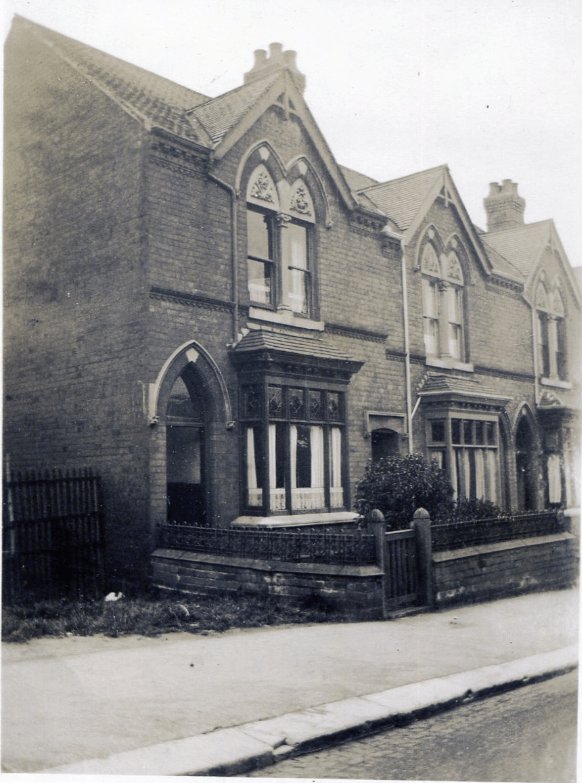
I was looking through some photos and certificates that my uncle had retrieved from the Hyland family home after the youngest, Rosie, had died when I came across an old photo of an end of terrace house that had no explanation on the back. My gut, and experience of both British and Irish residential architecture, led me to surmise that this photo, long kept, was Mollie’s home. So now I had a needle, the very large haystack of Birmingham and the as yet unproven idea that Mollie had lived in that house. But most of all I had a desire to find our missing Mollie.
Mary Teresa HYLAND, known as Mollie, was born 25 November 1889, at 9 Shandon St., Cork city. She was the oldest child of Patrick HYLAND and Mary Teresa EGAN.
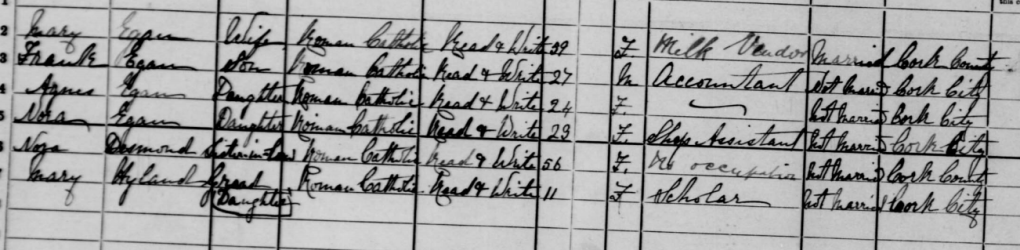
Mollie, then 11 years old, was not present in the Hyland’s Rosscarbery home when the 1901 census was taken. Where was she?
It took years but when the records were digitised I eventually found her at her maternal grandmother’s house in Cork city, amongst her EGAN aunts and uncles. Could it be that she had been attending school in Cork City, before the family moved back to the city? There hadn’t been a facility for girls’ education in Rosscarbery until 1894 when a small community of Mercy sisters were introduced, so an education in Cork city seemed likely.
In the 1905 newspaper report of the Coroner’s inquest into the Cork city burning accident and subsequent death of her younger sister, Agnes, Mollie wasn’t mentioned, unlike other siblings. Mollie would have been just 16 years old. Michael, my grandfather, had taken charge of the horrific situation, along with his nine year old sister, Catherine. Where was Mollie? Did she still live with her grandmother? Or was she already working by Monday 30th January 1905, possibly as a pupil-teacher? Or was she elsewhere altogether? [1]
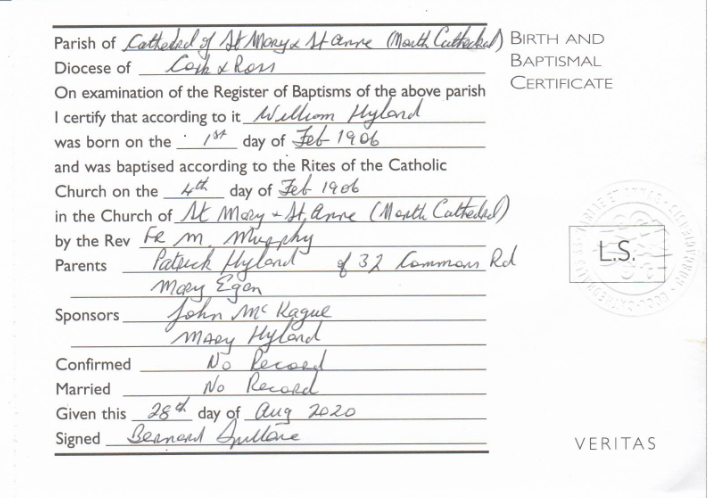
The last record I have found of Mollie in Ireland appears to be that of her as a sponsor of her youngest brother Billy’s baptism in 1906:
In 1911 Mollie would have been a young woman of 21 years. I have never found Mary Teresa Hyland in the 1911 census, in Ireland or England. I have scoured convents and institutions. EGAN relatives emigrated to the US but I haven’t found her in the 1910 or 1920 US Census records or the Canadian censuses of that period. [2] Many suffragists boycotted the 1911 Census, but I have no evidence that suggests Mollie was a suffragist. Was she, and where was she?
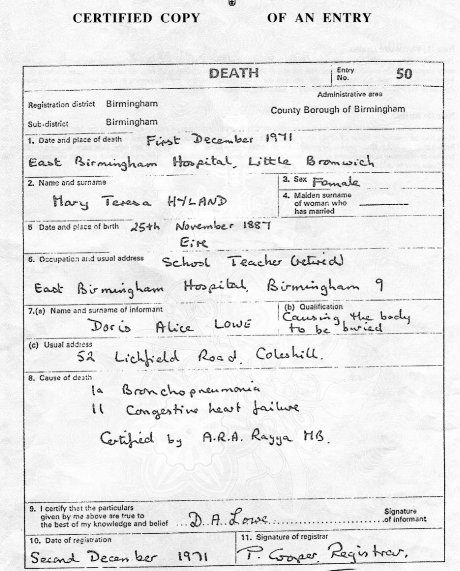
My aunt Maura associated the area of Erdington, Birmingham with Mollie. I found Mollie’s death certificate which confirmed the Birmingham connection.
She had died at a good age, 84 years and 6 days, in 1971 at the East Birmingham Hospital in Little Bromwich. Mollie died from bronchopneumonia and congestive heart failure.
Still nothing about Erdington though.
I remembered a family story that an aunt had been one of the first women to graduate from university. This seemed highly unlikely, given the long existence of the Irish universities as Queen’s Colleges. However, the Irish Universities Act of 1908 established the National University of Ireland, with three constituent colleges – including University College Cork. The first degrees of UCC were conferred in 1910. Is it therefore possible that Mollie could have been a first woman graduate? The Cork Examiner newspaper published the names of graduates of degree and diploma courses, and the examination achievements of intermediate and senior school students. Despite repeated searching of the newspapers I have found no record of academic achievement for Mollie. Her younger sister Bridget – whose academic achievements did make the papers – went on to train as a teacher in Limerick. Could Mollie have gone there?
Having been back in NZ for over five years, I spotted an international conference in my professional area that was going to be held in Birmingham. I submitted multiple abstracts for posters and a paper, so I had a good argument for attending. (It turned out to be an excellent conference, by the by.) However, I knew I needed a better plan than a hire car and a copy of a photograph to track down Mollie’s house and story. Where to start?
I submitted an enquiry, as daughter of the deceased’s now next of kin, to the latest NHS incarnation of the Birmingham hospital Mollie died in. I hoped they’d know where she’d been buried, what her home address had been and a bit of her medical history. I was particularly interested in finding out whether Mollie had had dementia, given her brother Michael seemed to have suffered from it and my mother was by then exhibiting signs of it. What’s family research without the practical angle! The Birmingham and Solihull Trust didn’t have the records. Heartland Hospital, formerly East Birmingham Hospital, did not keep records going that far back, so I needed to get more creative.
I wrote to the person named as having cause for the body to be buried, but unsurprisingly had no response.
I joined the Birmingham History Forum, an online community, and posted a request for help identifying which cemetery Mollie was likely to have been buried in. A few forum members pointed me in the right geographical direction. The Birmingham cemeteries would carry out a search for her name and death, but each search would cost £19.00, a reasonable sum in NZ dollars, so I wanted to narrow the search. Having identified the closest cemetery to Erdington as Witton, I noted the website wouldn’t take a credit card. I had to log a request on line and follow it up with a phone call, credit card in hand. Witton cemetery staff were forgiving – no need to pay the £19.00, but no record of Mollie. And on it went. Handsworth, Oscott, Brandwood End, Yardley, Quinton, Sutton Coldfield, Sutton New Hall, Lodge Hill, Key Hill, Warstone Lane, Kings Norton. I emailed requests to almost every cemetery in Birmingham, extending my net further and further afield, knowing from Google Earth maps that the likelihood of finding Mollie was growing more and more slim. Kindly, no-one charged me and my knowledge of Birmingham grew by each Google Earth search and swoop.
I posted a message on a Birmingham Old School Memories site but had no response.
One of my aunts believed Mollie had been a head teacher so I searched the names of principals of state schools from that period. Nothing.
I researched the history of Catholic Birmingham from the late 1890s onwards. Following the vague idea my mother had that Mollie had lived with nuns and had to move out when she was older to make way for some building works or some such thing, I emailed all the Catholic orders. I had some warm and encouraging responses from archivist nuns who were interested social historians and genealogists. Sisters of Mercy, Sisters of the Holy Child Jesus, Servite Convent of Our Lady of Compassion, Daughters of Charity, the Dominican sisters, and the Catholic diocesan archivist. None had records of Mollie; all wished me well in my search.
I spent a winter of evenings emailing other Catholic agencies from that period such as the Father Hudson’s Society which had had an education arm, hoping, failing but learning about the history of Catholic Birmingham. I waded through websites and pictures of early 20th century Birmingham. I spent hours on the running machine at the gym filtering through what I had in my head to try and work out what I knew and figuring out more strategies.
I was beginning to doubt Mollie’s death certificate, but I knew she had to have been buried in Birmingham somewhere as she was not buried in Cork with her siblings. As I was despairing of ever finding Mollie’s last resting place, a staff member at the Kings-Norton Cemetery responded to an email asking if Mollie was interred there with a now all too familiar “no record.” However, she did add to let her know if she could be of any help. After failing to find Mollie anywhere, and with my departure date for Birmingham looming, I emailed to ask her for any advice and this time adding that Mollie was Catholic. I still remember the excitement, searching a Catholic cemetery she suggested, but still no luck. And then the email came – the discovery of a death notice for Mollie, that had two jewels of information:
- Mollie had taught at Erdington Abbey School.
- Mollie was interred at the Abbey.
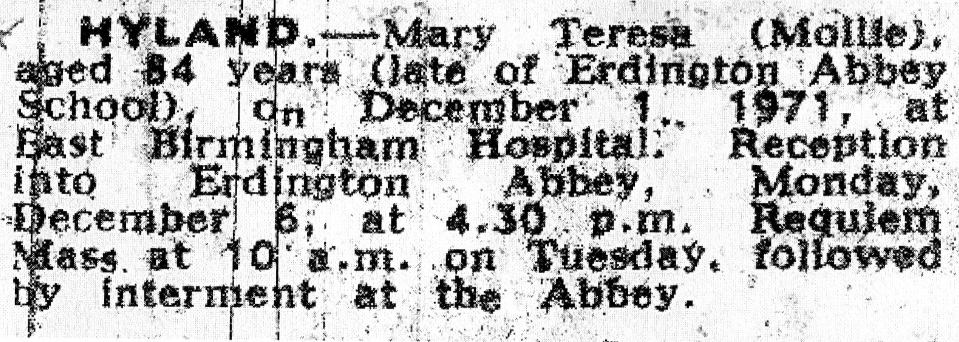
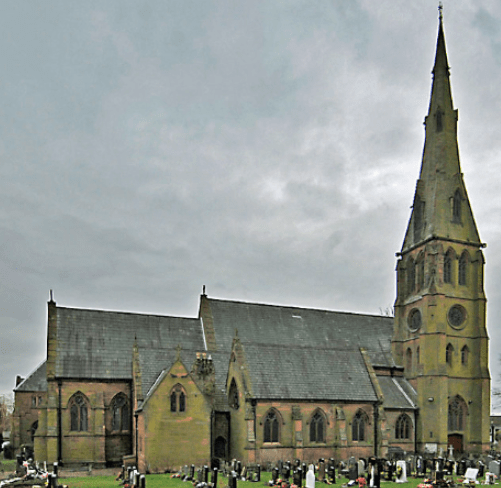
Erdington Abbey itself is the Parish of Sts. Thomas and Edmund of Canterbury. The Erdington Abbey senior school buildings, built in 1910, are now a private girls’ school, Highclare School. New building began in 1936. The Abbey primary still functions as a Catholic primary school.
I contacted the school and asked if they had any records but had no luck with accessing them.
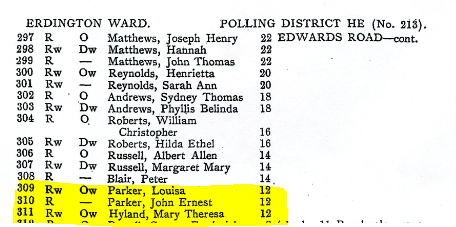
I subscribed to a set of historical Birmingham records, including electoral rolls. I found a record of Mary Theresa Hyland in the 1939 electoral rolls at 12 Edwards Rd, Erdington. We can see Mollie is listed under Rw – Women Residence Qualification and Ow – Occupation Qualification. I had an address!
Other resident electors at this address were John Ernest Parker and Louisa Parker.
Who were they?
Once I had this address I returned to Google Earth, but it looked like a car park. I scanned the photo of the house and asked Birmingham History Forum is “Does anyone know if this style of house could have been at 12 Edwards St, Erdington, earlier last century?…”. First, there was a negative response, and then a: “Very much so,” and another confirmation from someone who “walked down it yesterday.” I was linked to local real estate listings for Edwards Rd, and I could see the similarities.
A neighbouring similarly end-of-terrace house for sale in 2009 gives us an image of the property: Vestibule, hallway with stairs up to first floor, lounge, sitting room, kitchen, bathroom, three bedrooms, landing, loft. Bedrooms 4.27m x 3.73m; 4.02m x 2.55m; 3.75m x 2.6m.
The Calendar of Grants of Probate and Letters of Administration made to the Probate Registers listed:
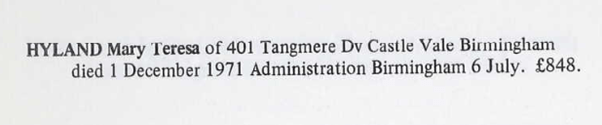
This suggested Mollie had moved into care for a brief period before her hospitalisation. The Electoral Rolls show another resident registered at 12 Edwards Rd from 1970 onwards.
Before I left for Birmingham I posted a request for a copy of Mollie’s intestate probate, and included the fee, a £ 5 note. I heard nothing. I trust someone enjoyed pocketing the fiver.
When I travelled from London’s Heathrow airport to the centre of Birmingham by bus, I passed many of the locations I had hovered over on Google Earth. It felt so familiar.
Post conference, I spent some hours in Birmingham City Library researching historical records. I discovered there had not been a telephone in the house at 12 Edwards Road under either Mollie or the Parker’s names, at least from the period 1929 – 1965.
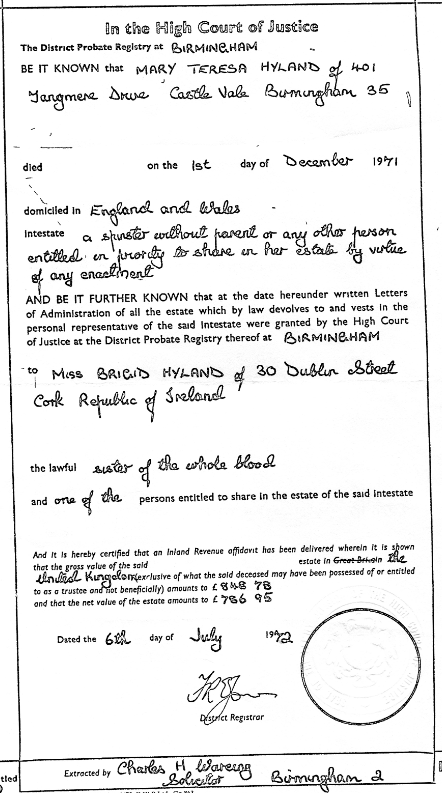
I resubmitted the request for a copy of Mollie’s intestate probate in person in Birmingham. Mollie’s younger sister, “Brigid Hyland of 30 Dublin Street Cork Republic of Ireland” was listed as the personal representative. Mollie left an estate of £848.78, with a net value of £786.95. That is about net £10,480 in today’s money. She did not have a proven will. [3]
I visited Erdington Abbey which was sadly locked. I found grave stones for the Parkers. I carefully picked through the small graveyard, but found no stone or marker for Mollie. I left my flowers at a statue of Mary.
I decided to pop in to Edwards Ave as it was so close to the Abbey. My delight was overwhelming when I found that 12 Edwards Ave did indeed still stand, much as it looked in the old photo. I had found the needle in the haystack, with perseverance, a well- located conference, and the kindness of strangers.
What have I learned since?
The 1921 census is the first record of Mollie living at 12 Edwards Rd. She is one of two boarders, the second being the Lancaster born Bernard McDonnell, also a teacher at the Erdington Roman Catholic school.

Mollie first appeared in the Electoral Rolls at 12 Edwards Rd, Erdington in 1930, aged about 41 years, along with Louisa and John Wesley Parker and their son John Ernest. [4] Louisa would then have been aged about 58.
She lived within sight of the spire of the Abbey, and a short walk to the Abbey and school.
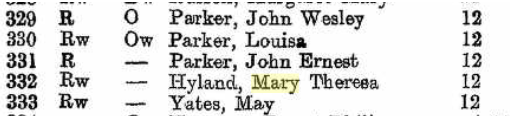
May Yates may have been the following May Yates, a teacher, shown living at 64 Grange Rd in the 1939 Register.

John Wesley Parker, died in the third quarter of 1938.
The 1939 Register shows Mollie still living at 12 Edwards Rd. She is listed as Mary T. Hyland Assistant Teacher.
The Parker’s second son, George Vincent, who had lived in Portugal and Malta, was living at 12 Edwards Road with his wife and son and stayed there the duration of the war. He was also an Assistant School Teacher. Had Mollie and George possibly known of each other prior to Mollie living there? Was George also a teacher at the Abbey?
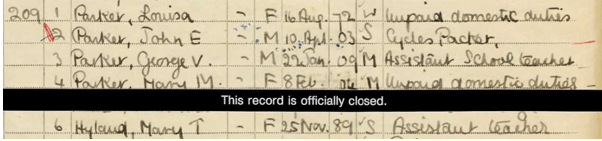
Number 12 is a two-story property, that in 1911 had six rooms excluding a bathroom. It is possible the house was split into two dwellings but it’s more probable that Mollie was a lodger, initially along with May Yates. (The single registrant at that address in the 1970 Electoral Rolls suggests it was one dwelling.)
In 1950 Louisa and son John Ernest lived at the house along with Mollie.

The electoral rolls show that by 1952 the only registered voters at 12 Edwards Rd were Louisa and Mollie.
Louisa died 12 April 1954. She and Mollie had lived at the same property for at least 33 years, far, far longer than Mollie had lived with her own family.
Louisa’s probate was granted on 14 May (1954) to Mary Theresa Hyland spinster and Charles Hodson Wareing solicitor. Effects £849 9 s. 7d.
Mollie was registered at the house until 1969. She had lived at 12 Edwards Rd for at least 48 years, of which 15 years were after Louisa’s death.
Uncle Jack’s idea that the ‘housekeeper’ got stuck into Mollie’s money seems to have been turned on its head. Whatever the relationship between Mollie and the older woman, it would appear to have been an enduring friendship.
In 2016 I linked with a former student of the Abbey school, through the Birmingham History Forum. He sourced Mollie’s grave number for me. He remembered Mollie teaching the ‘A Stream’ in the senior school, which was a mixed sex school at that time. This suggests she was well educated. He recalls Mollie retiring in about 1953, but promptly returned to teaching. This was a pattern to be repeated by her younger sister Bridget.
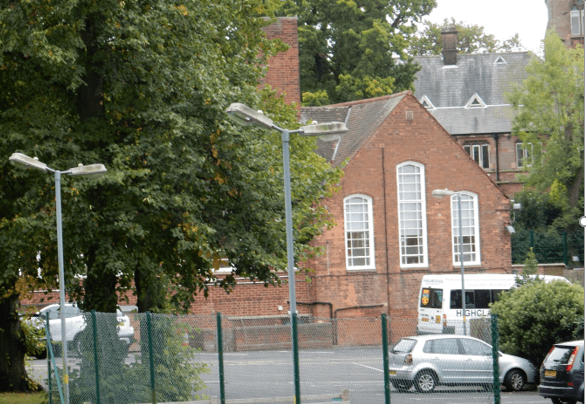
In correspondence the Catholic historian, Michael Hodgetts, told me ‘I remember Miss Hyland from when I was at the Abbey School as a small boy (till 1947), and she was a friend and fellow whist-player of my parents.’
I hope eventually to uncover where Mollie was between the 1906 baptism of her brother and turning up in the records in Edwards Road in 1921, aged 31 years.
Mollie is interred in Grave A – 130 B. This is to the left of the stone in the foreground.
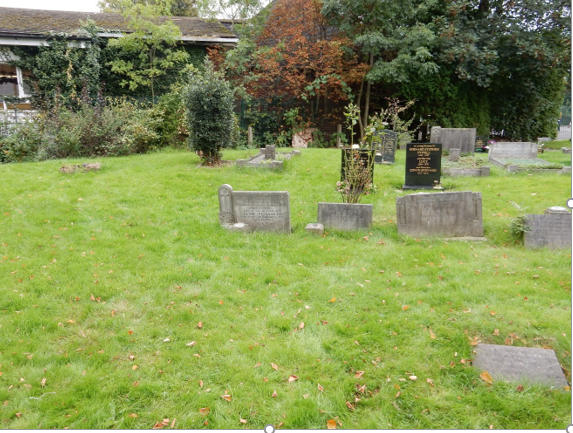
I am pleased to know that I left the flowers close to her final resting place.
Synchronicity.
Update
[1] Could there be some accuracy in my aunt Maura’s idea that one of the girls was educated in France? If this is the case, what does it say about the Hyland’s aspirations for their oldest daughter?
[2] There are Mary Hylands of a similar age who were servants in the US, but I do not know how likely it would be that Mollie would have gone to the US as a servant and then gone on to Birmingham as a teacher.
[3] Maura recalls getting about 20 quid; Jack thought about 16 quid. Bridget must have split the estate between Mollie’s siblings, and my grandfather Michael’s children would have received a split of Michael’s share.
[4] John Ernest Parker entered the UK airforce, aged 16 years enlisting in 1919. He died in 1982, in Bromsgrove, Worcestershire.
In the 1911 census the Parker’s neighbour, Emma Starkey, a 54-year-old widow and mother, was the Caretaker of R.C. Schools. Could there have been any link between Mrs Strakey and Mollie coming to live with the neighbours?
The Parker’s second son, George Vincent, was a 21-year-old student when he returned to 12 Edwards Rd. from Buenos Aires on June 1930. He listed Lisbon, Portugal as his place of residence. He left the UK again.
George Vincent then arrived from Malta, 13 July 1939, intending to live in the U.K. He was a teacher. He arrived with “Mary May Parker”, given age 35 years, and son, Stanley John, aged 2 years. There are no records to show that G.V. Parker went to war.
George, and Stanley John, aged 9 years, departed to Malta in 1946. It seems they stayed the duration of the war. There was no record of Mary May Parker, or any other children on this ship. Nor is there a record of the death of Mary May Parker, 1936-1946; or of her boarding another ship around those years.
 In Search of Thomas Davis
Love all the info you sent through today , fascinating , thanks so much , really building a picture now !
Sent from my iPhone
>
LikeLiked by 1 person
Dogged and patient, your research and results are wonderful. Thank you.
LikeLike