Michael HYLAND was born 19th December 1890 at 9 Shandon Street, on Cork’s north side. He was the second child and oldest son of Patrick HYLAND, originally from County Laois, and Mary Teresa EGAN of Cork. Michael is my grandfather.

Michael spent his childhood in Skibbereen and Roscarbery, County Cork, where his father served as an R.I.C. Constable. The family returned to north Cork city around 1904 and settled at 30 Dublin Street in Blackpool.
It seems Michael took Finbarr as his confirmation name as he later used it as a middle name. (Finbarr was the Patron saint, and a former bishop, of Cork.)
Michael was 15 years old when he tried to save his younger sister Agnes from a fatal fire in 1905. (See later post on Agnes.)
Michael started work with the railways on 11 May 1907. He was not yet 17 years old. Aside from during WW1 Michael spent his working life on the railways.


Source: Great Southern Railway staff returns
In the 1911 Census Michael gave his occupation as Engine Cleaner. He spent his working life on the railways. [1] Michael recorded he spoke both Irish and English.
Michael joined the National Union of Railway Men on 17/8/1913 when he was 23 years old. He was then a fireman for Great Southern and Western railways, and joined the Cork Union Branch 1.
According to his son Jack, Michael Hyland played football (soccer) for the original Cork Bohemians. Michael followed Sheffield Wednesday, and there was a poster of Sheffield Wednesday in the scullery at Sarsfield St.
WW1
Michael gave his occupation as Soldier at the time of his marriage in 1920.
Michael served in the army from 1914 to 1920. It seems miraculous that, unlike his younger brother, he survived the war. He was initially a gunner in the Royal Garrison Artillery, regimental number 43240. Michael was awarded the 1914-1915 Star (for service in any theatre of war outside the UK between 5 August 1914 and 31 December 1915. ) He had disembarked 12 June 1915.
The 20th Siege Battery of the RGA is recorded as having first been in France 19 June 1915, so Michael may have been with the 20th as this is the nearest date to his disembarkation.[2]
Michael then served in the Railways Operating Division of the Royal Engineers (R.O.DRE), regimental number 125484.
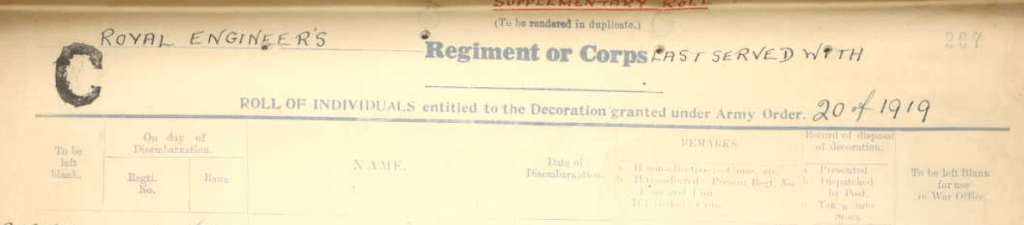

He achieved the rank of Acting Corporal, the first of the ranks of non-commissioned officers. He was also awarded the British War Medal and Victory Medal.
60% of First World War service records were destroyed when the Ministry of Defense was bombed during the Blitz. Unfortunately, it looks likely that Michael’s enlistment, service and pension records are amongst those lost.
My uncle Jack reported that ‘dada’ played rugby whilst in the army. Jack thought it was possible that, after the war, Michael went to England before coming home.
Having lost his younger brother in WW1 Michael wanted to sign up for WW2 but was too old.
Marriage
Michael married Mary Brigid DAVIS on St. Valentine’s Day 1920 at the North Cathedral, Cork. Witnesses were Mary’s younger sister Madge and a Pat McNamara.[3]
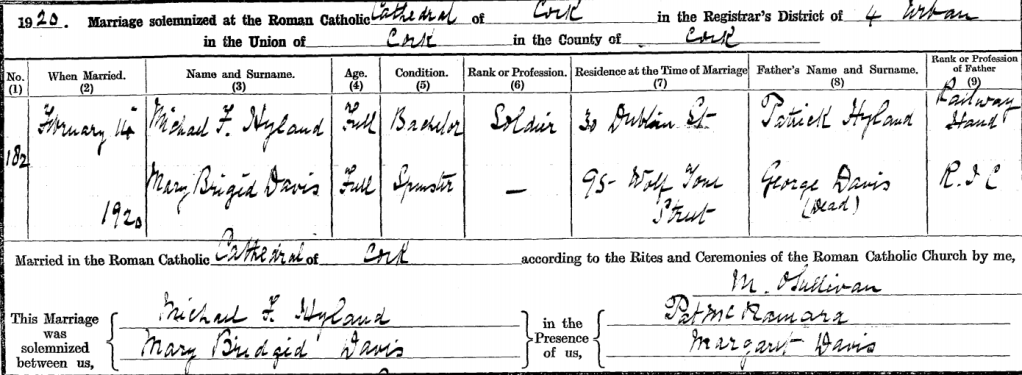
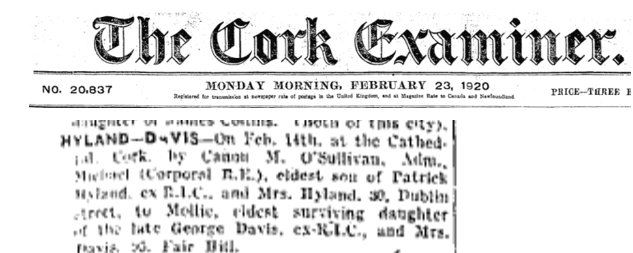
Cork in 1920 would have been a very tense place, culminating in the ‘Burning of Cork’ on December 12th by British forces. Mick and Mollie’s wedding notice was in the paper, clearly stating Mick’s military role and positioning the families as ex-R.I.C.
Family, residence and work
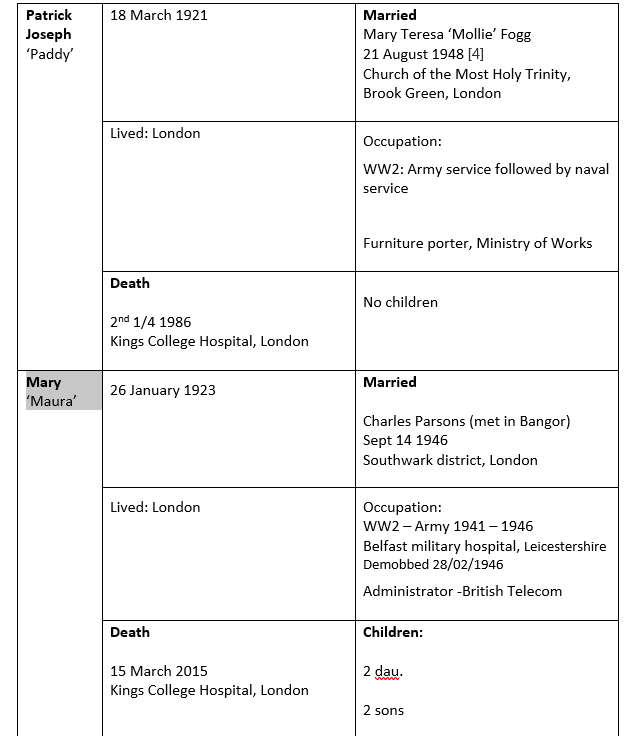
Michael and Mary Bridget (Davis) HYLAND had the following children:
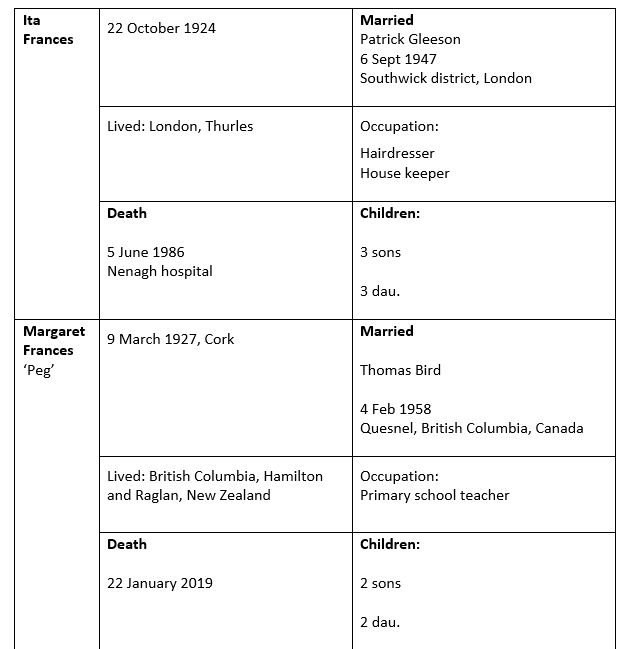
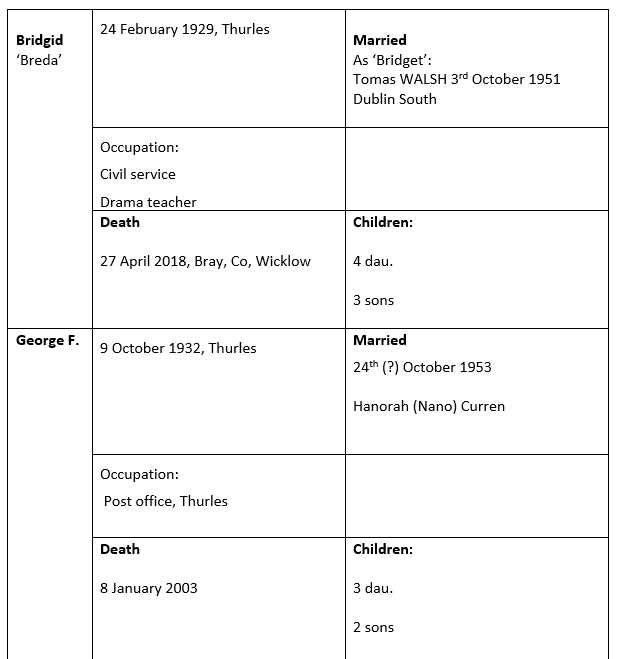
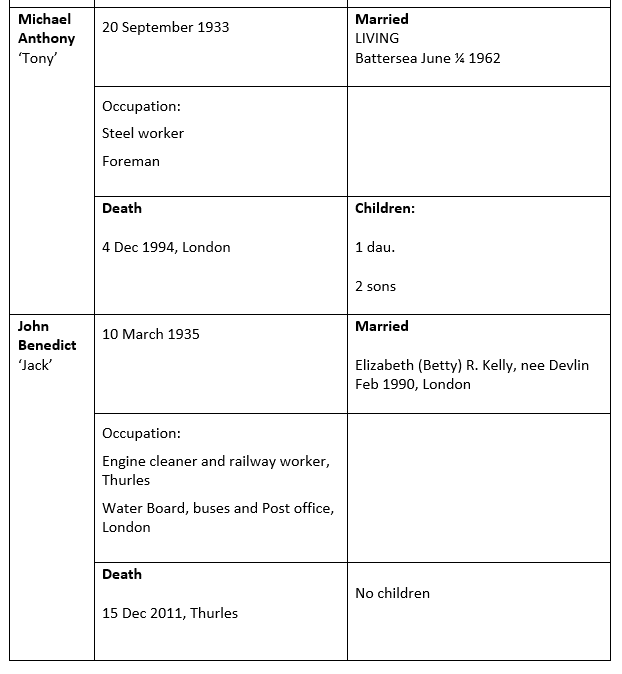
With his young family of three children Michael worked in Kenmare, Co. Kerry briefly.
By 1927 Michael and family were back in Cork city, living at 47 Gerald Griffin Street, beside the North Cathedral and his occupation was locomotive driver. Also living with them was Mary’s widowed first cousin, Kitty (Furlong) DOWLING.
By 1929 Michael and family, then consisting of four children, had moved to Sarsfield St., Thurles, County Tipperary, where he and Mary had a further four children. He lived for the remainder of his life at 8 Sarsfield St.
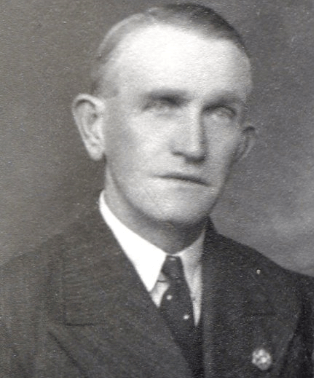
Michael’s railway experiences included being threatened three or four times by the old IRA who were robbing trains. He was also injured when he was hanging out of a train in the dark and hit going through a tunnel, crawling to the safety of a nearby house with a profusely bleeding head injury.
Michael became a senior train driver.
Michael was very active in Associated Society of Locomotive Engineers and Firemen (ASLEF), the union for train drivers, including being Chairman of the Irish District Council. [4] At his retirement he was honoured as a footplateman (locomotive engineer who operates the controls) and unionist.
(Córas Iompair Éireann (CIÉ), Ireland’s national public transport provider, came into effect on January 1st 1945.)
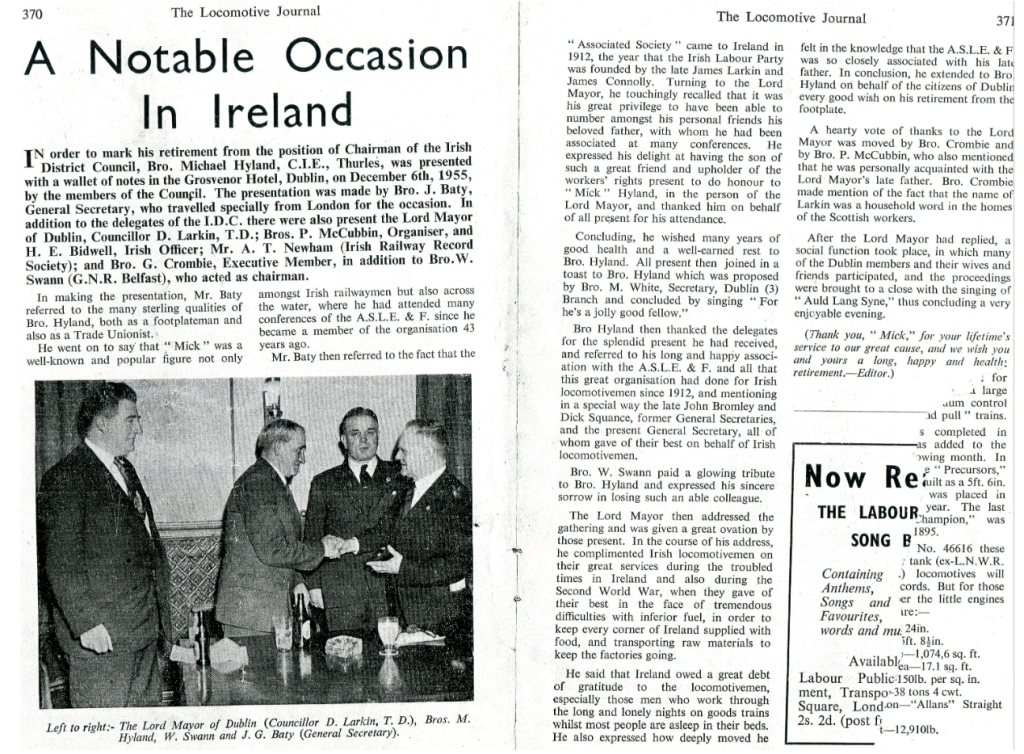
My mother described Michael as always a Labour supporter.
Michael followed Sheffield Wednesday football team, and there was a poster of Sheffield Wednesday in the scullery at Sarsfield St.
Michael, my mother recalled, sang at the Feis Ceoil: ‘He had a nice voice, mama taught him stuff for it. ‘
A daughter recalled her father’s expression:’ Never said hello, good day, kiss me arse, or good moro.’
Death
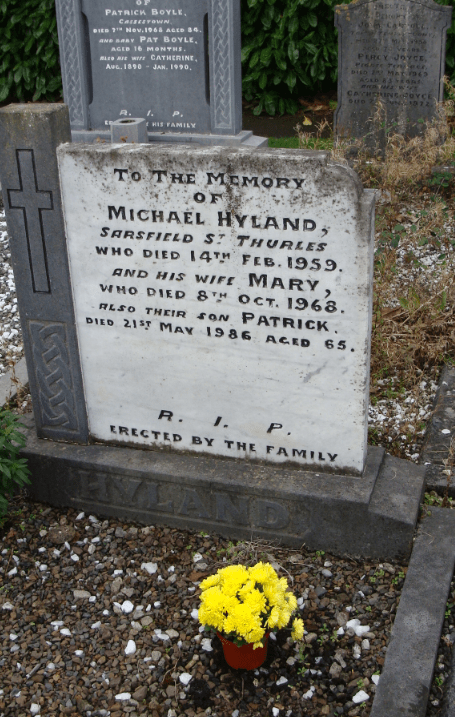
Michael died on 14th February 1959, 39 years to the day he had married Mary Davis. He died at Thurles Hospital of the Assumption, age 69. He had experienced a cerebral haemorrhage for a week and also had arteriosclerosis. (This can occur when arteries grow thick and stiff and restrict blood flow to organs and tissues in the body.)

Michael is buried at St Patrick’s cemetery, Loughtagalla, Thurles.
[1] Michael’s father (after retirement from the R.I.C.) and three younger brothers also worked on the railways.
[2] The Long, Long Trail: <https://www.longlongtrail.co.uk/army/regiments-and-corps/the-royal-artillery-in-the-first-world-war/the-siege-batteries-of-the-royal-garrison-artillery/> [accessed 28 November 2021]
Siege Batteries RGA were equipped with heavy howitzers, sending large calibre high explosive shells in high trajectory, plunging fire.The usual armaments were 6 inch, 8 inch and 9.2 inch howitzers, although some had huge railway- or road-mounted 12 inch howitzers. Source as above.
[3] I have searched for deaths of Cork based Patrick McNamaras. None were given as having been C.I.E. workers. A Patrick McNamara, from Limerick born 1890, i.e. the same age as Michael, had served in the Rw Fusiliers Special Reserve. Could this be the connection to Michael? At the outbreak of war the Royal Munster Fusiliers three reserve battalions were all mobilised on 4 August 1914.
[4] My mother recalled running into her father in the street while he was up in Dublin on his union business, when she was training as a teacher in Dublin city.


I understood that our Grandfather was working in Sheffield when he enlisted into the army .
LikeLike