A not so Great War
I knew from childhood that my mother had lost an uncle during the Great War. John HYLAND, Jack as he was known, was born in Skibbereen on 16th August 1892. He was the third child and second son of Patrick and Mary Teresa (Egan) HYLAND, the next in the family after Mollie and my grandfather Michael.
In the 1911 census, Jack was listed as an Engine Cleaner. He had presumably followed his older brother Michael into work on the railway. Living at Commons Road, Cork, at that time they were at the Kent Station side of the city.
We do not have a lot of information about Jack, aside from his military records. We can assume he was educated at the North Monastery where we know from his military records he had reached Standard 5 in his schooling. The Examiner carried a story on Wednesday, February 25, 1914 (page 9) announcing the players who would be competing for Cork County versus University College in a GAA match in the opening round of Tramway Cup. One J. Hyland is listed. It may be this is Jack, given the Hyland passion for Gaelic sports. (The GAA Club that his younger brother played senior hurling with, Glen Rovers, was not founded until 1916.)
When Jack enlisted for the service in WW1 he was a Fireman on the railways. Jack was one of 11,569 men who enlisted in the Cork recruiting area.
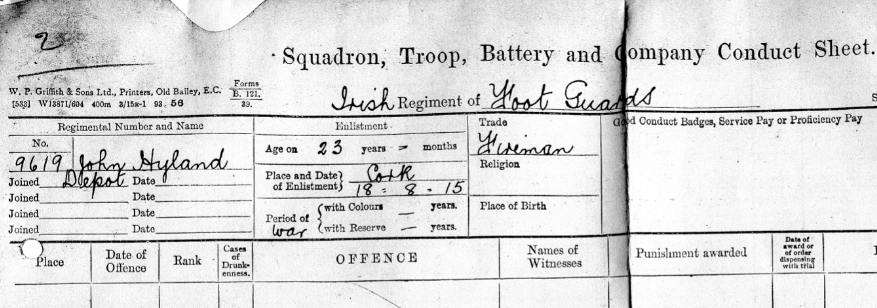
Jack enlisted at Cork on the 18th August 1915, for the Irish Regiment of Foot Guards. His regimental number was 9619.
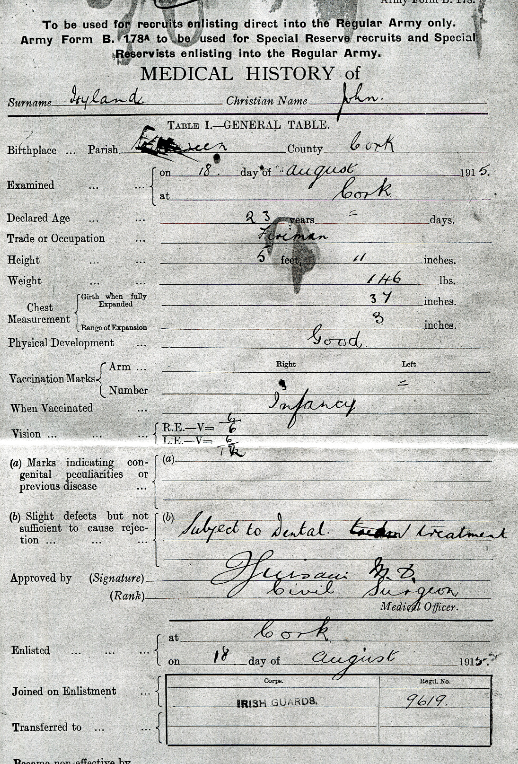
His records show that he was 5 feet, 11 inches tall, just a little taller than his father. He had a 37 inch chest and a 3 inch range of expansion. Jack weighed 146 lbs (10 stone, 6 pounds or 66.2kg), and had good “physical development.” His right eye had 6/6 vision, his left 6/12. He required dental treatment.
Enlistees were required to sign an oath of allegiance to the King. Seemingly many records of Irishmen fudged this oath, but Jack can be seen to have signed his name. While we have no other signature to compare it with we can assume that, given the R.I.C. connection of his father, it appears these Hylands had no issue with the state as was.

Jack arrived at Caterham, Surrey, England on 21 August, 1915. There he received his typhoid vaccinations on the 16th and 30th September 1915. Caterham was then the Irish Guards training depot. Recruits underwent a 16 week training period.
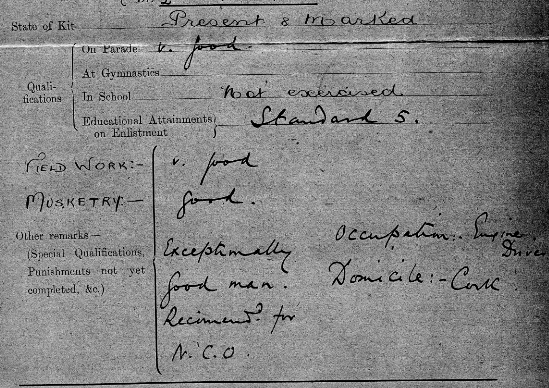
John then joined the 3rd reserve battalion on January 4th, 1916. His record states he was an Engine Driver. Also, that he was ‘V. Good’ on parade.
His field work was ‘V. Good’, and his Musketry was ‘Good’.
Also noted was that he was an: ‘Exceptionally good man’ and he was recommended for N.C.O., that is Non- Commissioned Officer.
Jack embarked for France at Southhampton on 26 August 1916. He landed at Harfleur (Normandy, Northern France) on the following day. He arrived in the field from their base on 16th September then transferred to the Guards Division on the 21st, as part of the Expeditionary Force.
Jack died from wounds on the 24th September 1916.

He had been in service 1 year and 38 days and in the field only a few days.
The following notice appeared in the deaths notices on the front page of the Cork Examiner on Saturday Morning October 14, 1916:
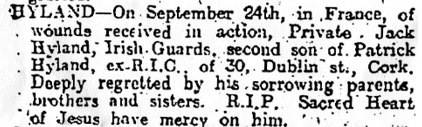
There was no mention of Jack in the Cork Examiner casualty lists up to the period November 8th.
Rudyard Kipling’s regimental history of the Irish Guards enabled me to piece together the story of Jack’s death, summarised below: [1]
The 1st Batallion suffered severe losses in their operations at Ginchy, on the 15th of September. They required new drafts for operations in the immediate future. Over 300 recruits were sent up, and this would have included Jack, who arrived on the 21st. They were initially employed clearing up the litter of battle. The Battalion was then preparing for its second Somme Battle, to commence on September the 25th, involving an attack on the Lesboeufs village.
Catholic chaplain Father Casey said mass in the woods on Sunday 24th. They were shelled and a single shell injured thirteen men and killed two. As there is no other reference to injuries between the 21st and 24th, except to one of the priests, it is my assumption that Jack was one of the men killed, and the second man may be T. Loundes who is buried beside him. Having been at the front for only nine days, I hope that Jack saw little of the horrors of the Somme, and that he died quickly that night.
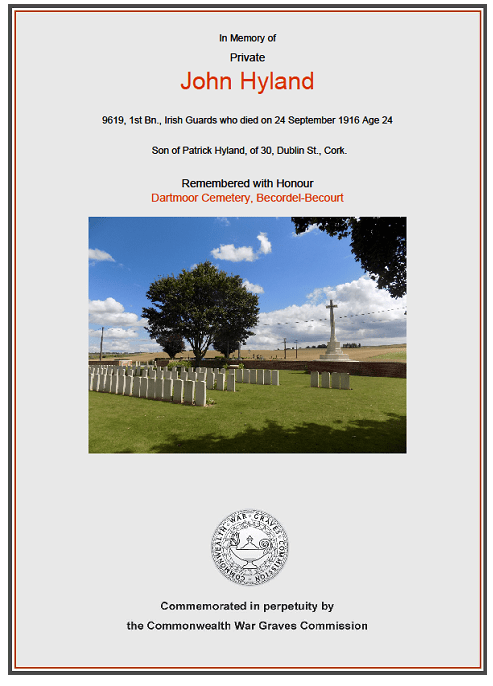
Jack is buried at the Dartmoor Cemetery, Becordel-Becourt, 2.5 miles South East of Albert, north of the village of Becordel-Becourt, in Grave II. C. 58.
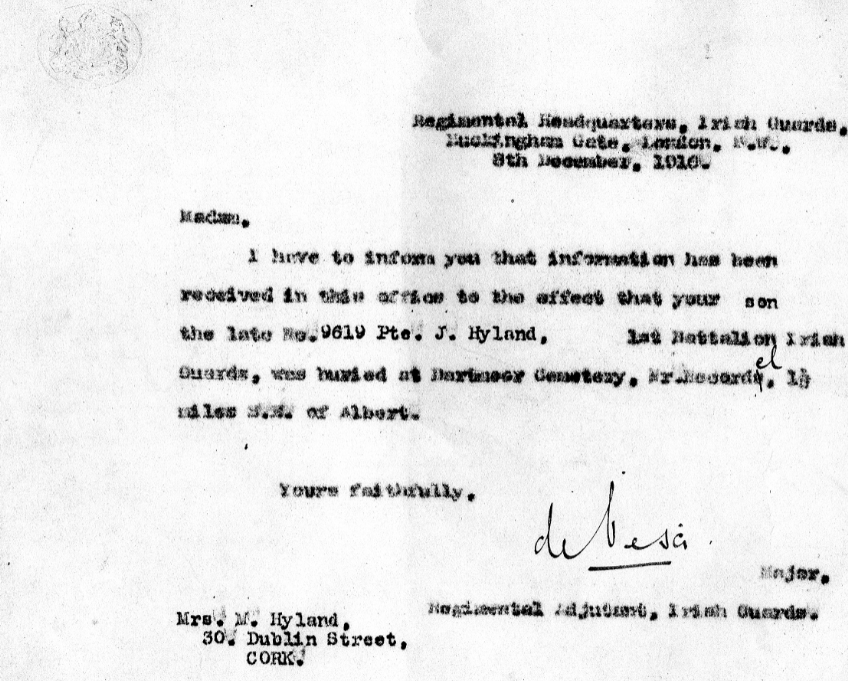
A message to Jack’s mother was sent from the Regimental Headquarters of the Irish Guards at Buckingham Gate, London, on the 8th December 1916. It notified the family of details of Dartmoor Cemetery.
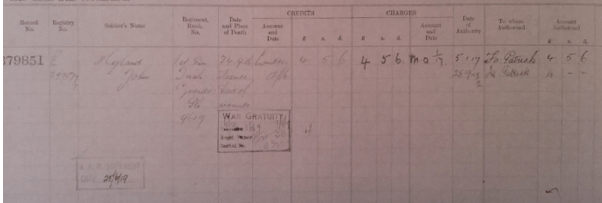
Jack’s mother was named as next of kin on his Pension Ledger Card.
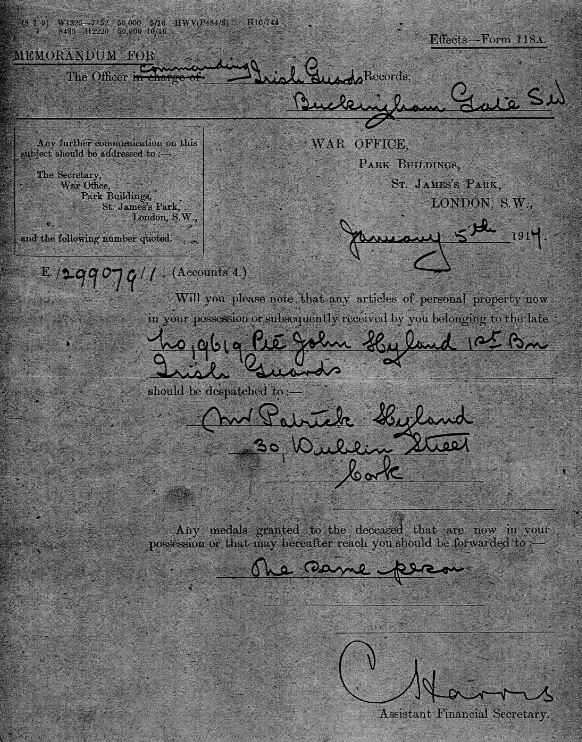
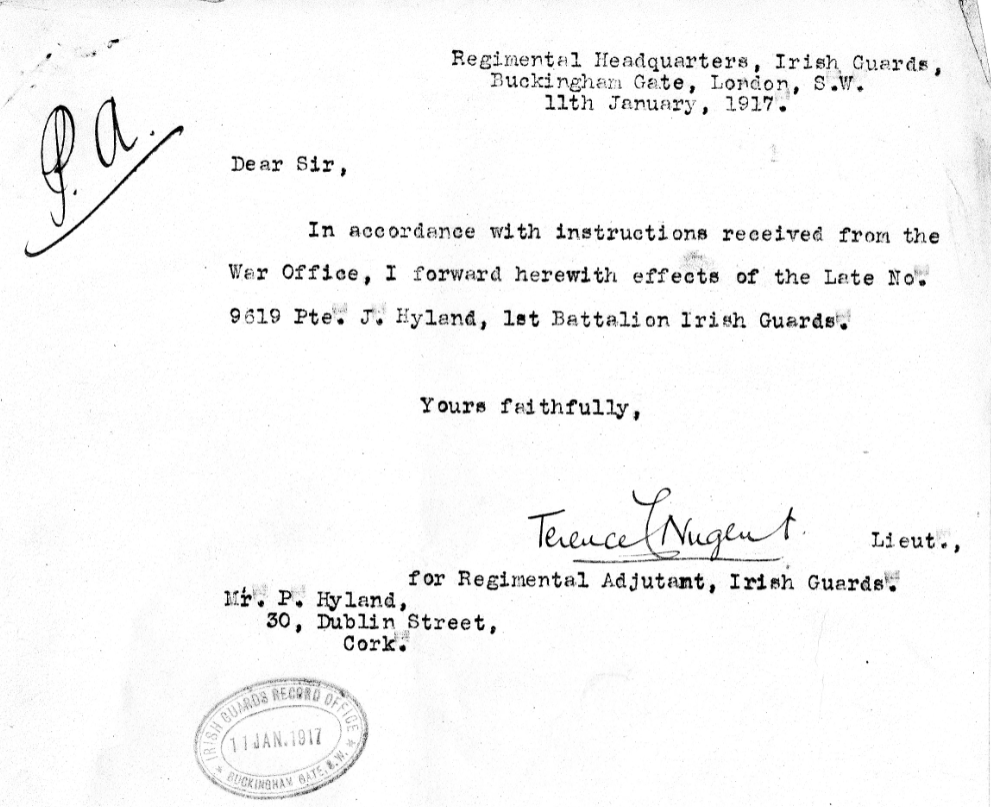
The War Office sent a memo to the Irish Guards on January 5th, 1917 requesting they despatch any personal property belonging to Jack to his father, and any medals granted. These effects were forwarded on January 11th, 1917.
Jack’s father Patrick Hyland received payments relating to Jack’s death.
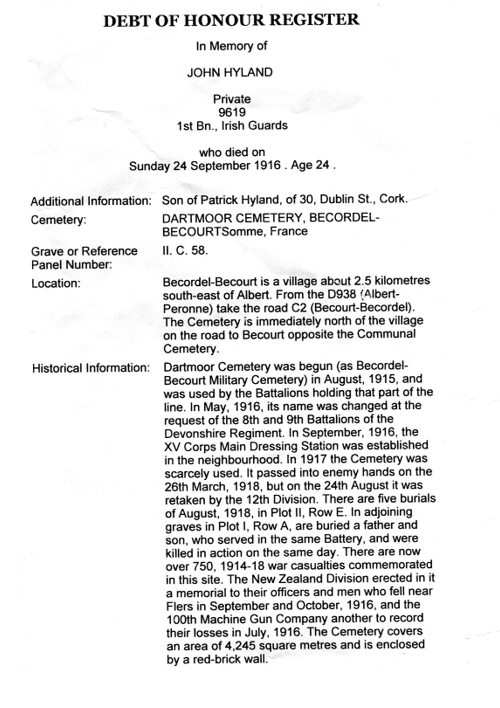
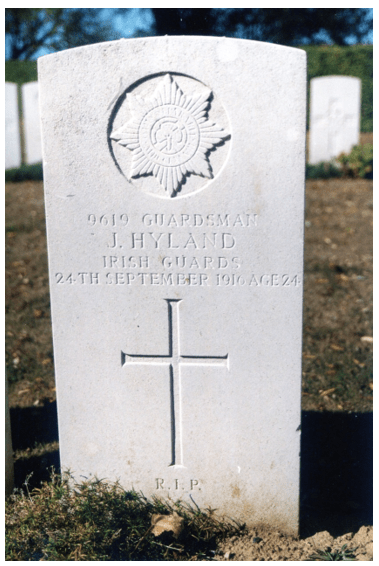
I visited Dartmoor Cemetery in the early 2000s and again in 2019. It is deeply sobering, driving past the flat fields of the Somme, cemetery after cemetery. I wept when I first saw Jack’s grave in the rows upon rows of graves of the over 750 men buried there. He lies between a fellow Irish Guardsman who died the same day, and a solider from the New Zealand Otago Regiment.
The entry in Ireland’s Memorial Records 1914 -1918 reads:
HYLAND, JOHN. Regimental No. 9619. Rank, Private, Irish Guards, 1st Batt.; died of wounds, France, September 24, 1916; born Skibbereen, Co. Cork.
The Hyland family received the Death Plaque, British War Medal and Victory Medal following Jack’s service [2]:
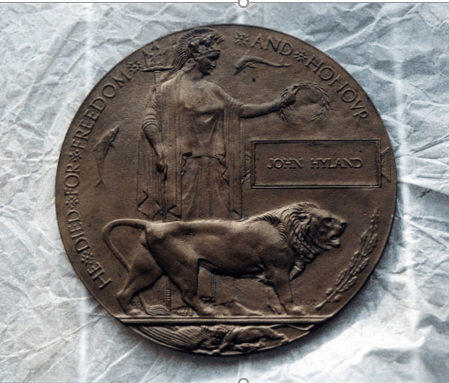
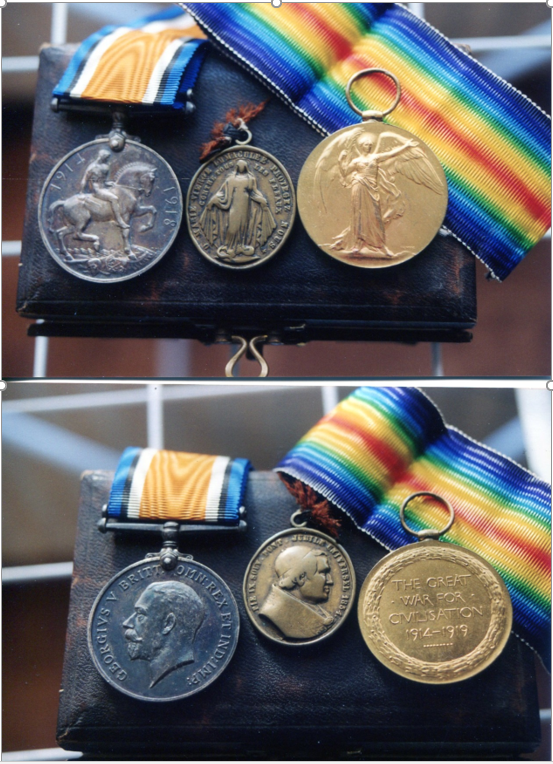
The military medals were kept by Jack’s siblings after his parents’ deaths, along with a medallion of the Mary Immaculate (centre) with a French inscription: O Marie Vierge Immaculee Protegez Nous. Contre tous les Fleux (Oh Mary Virgin Immaculate, protect you against all the flames).
We will remember him.
[1] Rudyard Kipling wrote a two book regimental history of the guards in honour of his son, Jack, who had served and died as an officer in the Irish Guards.
[2] WW1 Death Plaque – 12 centimetre disk cast in bronze gunmetal. On the outer edge is the inscription, ‘He died for freedom and honour’. The memorial plaque was posted to the next of kin protected by a firm cardboard purpose made folder, which was then placed in a white HMSO envelope.
British War Medal. This was authorised in 1919. The basic requirement was having either entered a theatre of war or served overseas between 5 August 1914 and 11 November 1918.
Victory Medal. This was authorised in 1919 and awarded to personnel who had served in an operational theatre.
 In Search of Thomas Davis
Thanks for filling in the details on some of Jack’s life & his tragic death . Oh to be able to go back in time …
Sent from my iPhone
>
LikeLiked by 1 person